How to Choose an AI Development Partner: A Ten-Point Framework
How to choose an AI development partner: ten criteria, the evidence to request, red flags, a weighted scorecard and a paid pilot to test your shortlist.
How to Choose an AI Development Partner: A Ten-Point Framework
To choose an AI development partner, score every shortlisted vendor against the same ten criteria, weight the ones that carry real risk (production evidence, evaluation discipline, data security and IP terms) most heavily, ask for documents instead of promises, and let a short paid pilot settle the final decision. Demos and slide decks should count for almost nothing.
The rest of this guide covers each criterion, the evidence to request, the red flags that should end a conversation, and a weighted scorecard you can copy into a spreadsheet.
Why is choosing an AI vendor harder than choosing a software vendor?
With conventional software, a competent vendor can tell you roughly how the system will behave. With LLM applications, RAG systems and AI agents, nobody knows how well the system will perform on your data until it has been built and measured. That uncertainty shifts the selection question from "can they write the code?" to "can they prove, with numbers, that what they build works, and tell you honestly when it doesn't?"
The failure rate makes this concrete. In July 2024 Gartner predicted that at least 30% of generative AI projects would be abandoned after proof of concept by the end of 2025, citing poor data quality, inadequate risk controls, escalating costs and unclear business value. A good partner reduces every one of those four risks. A weak one hides them until after the contract is signed.
This framework covers general AI vendor selection. If you are specifically evaluating embedded, on-site engineers, the companion guide on choosing a forward deployed engineering company goes deeper on that model.
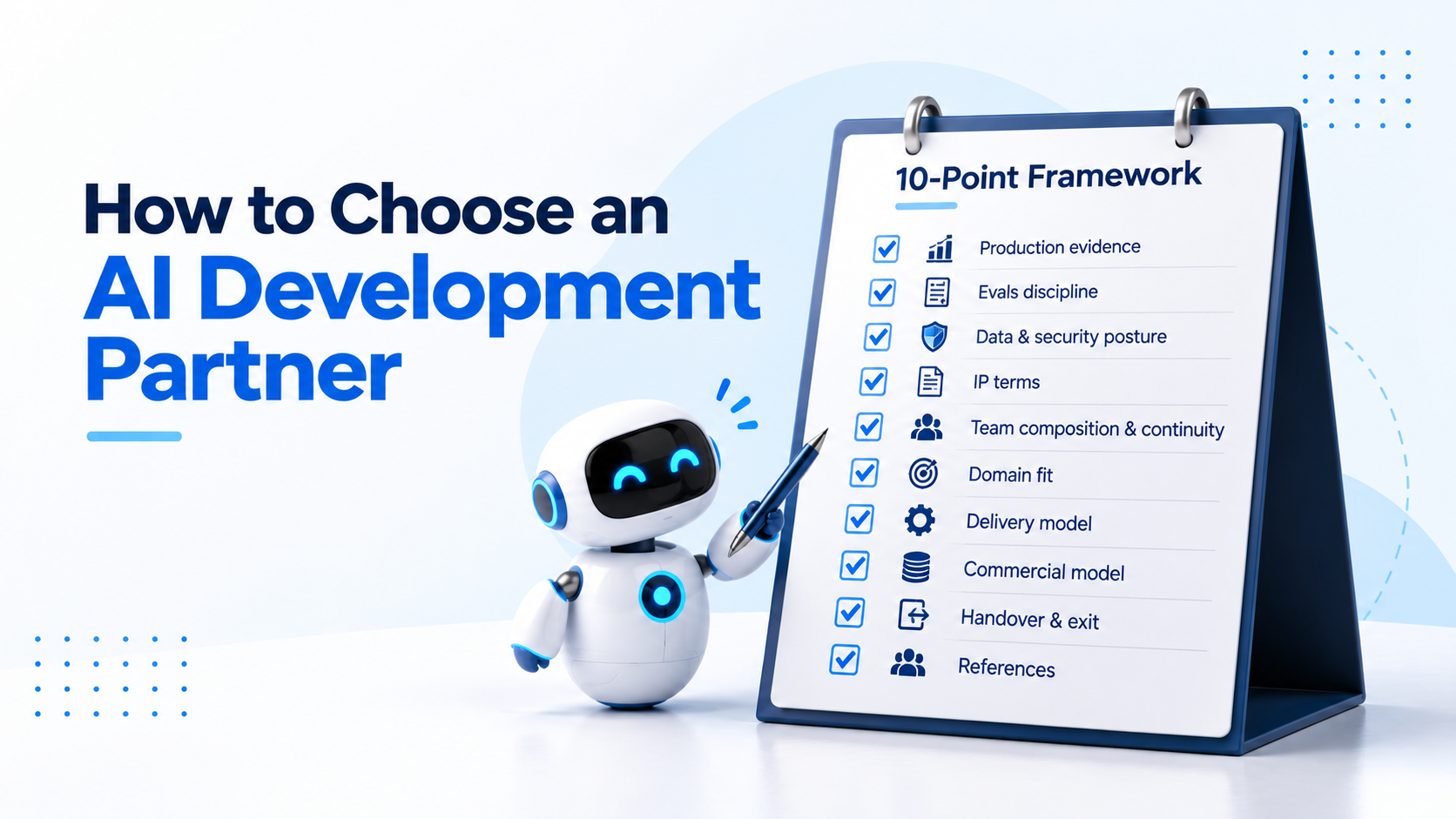
The ten criteria at a glance
| # | Criterion | The question it answers | Suggested weight |
|---|---|---|---|
| 1 | Production evidence | Have they shipped AI that real users depend on? | 15% |
| 2 | Evals discipline | Can they measure whether the system works? | 15% |
| 3 | Data and security posture | Will your data be safe in their hands and their stack? | 15% |
| 4 | IP terms | Will you own what you pay for? | 10% |
| 5 | Team composition and continuity | Who actually does the work, and will they stay? | 10% |
| 6 | Domain fit | Do they understand your industry's data and constraints? | 8% |
| 7 | Delivery model | How do they plan, ship and report progress? | 8% |
| 8 | Commercial model | Does the pricing structure align incentives? | 7% |
| 9 | Handover and exit | Can you walk away without the system collapsing? | 7% |
| 10 | References | Do past clients confirm the story? | 5% |
The weights are a starting point: a healthcare buyer might push data and security to 20%, while a startup racing to a first release might raise delivery model. Agree the weights with stakeholders before the first vendor call, so nobody reverse-engineers them to favor a preferred vendor.
How do you evaluate an AI development vendor on each criterion?
For every criterion below you get three things: what to look for, the evidence to request, and the red flags. Evidence always beats assertion. If a vendor says "we do that," the follow-up is "show me."
1. Production evidence, not demos
Look for: systems running in production with real users, real traffic and real consequences when they fail. A demo on curated data never meets the long tail of messy inputs that makes AI engineering hard.
Evidence to request: a walkthrough of one live system (architecture, traffic volume, failure modes they have hit and fixed), post-incident notes with client details redacted, and monitoring dashboards shown in a screen share.
Red flags: every example is a prototype, a hackathon project or an internal tool; the vendor can't describe a production incident; case studies describe "potential" savings rather than measured outcomes.
2. Evals discipline
This criterion separates AI engineering teams from general development shops. An evaluation suite ("evals") is a set of test cases, graded automatically where possible, that measures how well an AI system performs a task. Anthropic's documentation says good success criteria should be specific and measurable, and that evals should mirror the real-world task distribution, including edge cases.
Look for: a team that asks how you will define success before it talks about models, and that treats evals as a deliverable you keep.
Evidence to request: a sample eval plan from a previous project, the metrics they track (accuracy, groundedness, latency, cost per task), and how they run regression evals when a prompt or model version changes.
Red flags: "we'll test it manually," success defined as "the client is happy," or no answer to "how would you know if a model upgrade made things worse?"
3. Data and security posture
Look for: a clear account of where your data goes, who can see it, and which third-party model providers process it. For example, OpenAI states that it does not train on API business data by default and may retain API inputs and outputs for up to 30 days, with zero data retention available for eligible use cases. A serious partner knows these terms for every provider they propose.
Evidence to request: a completed security questionnaire, their access-control and offboarding policy, any third-party audit reports, and how they defend against LLM-specific threats such as those in the OWASP Top 10 for LLM Applications (2025), including prompt injection, sensitive information disclosure and excessive agency. If they cite SOC 2, ask for the report itself and check whether it is Type 1 (controls designed properly at a point in time) or Type 2 (controls operating over a period), as Secureframe explains.
Red flags: engineers working on personal laptops with production data, no answer on prompt injection, a certification logo on the website but no report available under NDA.
The article on data security in offshore AI development lists twelve specific controls if you need a deeper checklist.
4. IP terms
Look for: contract language that assigns to you all rights in code, prompts, eval datasets, fine-tuned weights and documentation created for your project, with a clear carve-out list for the vendor's pre-existing tools and a license for you to use them.
Evidence to request: their standard MSA and SOW templates early, not at the end. Check how IP flows from individual engineers and subcontractors to the vendor, because assignment to you only works if the vendor owns it first.
Red flags: vague "background IP" clauses that could cover most of the system, ownership that only transfers on final payment of the entire program, or refusal to disclose subcontractors.
Rules differ by jurisdiction. The guide on IP ownership in offshore AI development covers the cross-border detail. This is general information, not legal advice; involve your counsel before signing.
5. Team composition and continuity
Look for: named engineers with relevant experience (LLM integration, retrieval, agent orchestration, MLOps, product engineering), and a commitment that the people you interview are the people who build.
Evidence to request: CVs or profiles of the proposed team, the vendor's replacement process if someone leaves, notice periods, and their typical engineer tenure on a client account.
Red flags: the senior architect who ran the sales call disappears after kickoff (the "bait and switch"), a team assembled only after signature, or no contractual right to approve replacements.
6. Domain fit
Look for: familiarity with your data types, workflows and regulators. A partner who has worked with clinical notes, insurance claims or trade documents will anticipate problems a generalist learns the expensive way.
Evidence to request: examples in your sector or an adjacent one, and a short written note on the three biggest risks they see in your use case.
Red flags: identical proposals for every industry, or confident claims about regulations they can't explain in plain terms.
Domain fit carries moderate weight because strong teams learn domains quickly. Healthcare buyers should add the 12-point healthcare partner checklist.
7. Delivery model
Look for: a working cadence you can inspect: sprint length, demo rhythm, how scope changes are handled, and how eval results are reported to you. Ask whether they work as a dedicated team, augment your staff, or run a fixed-scope project, since each model shifts accountability differently.
Evidence to request: a sample sprint report, a sample status update from a past engagement (redacted), and the time-zone overlap they commit to with your team.
Red flags: progress reported as hours burned rather than outcomes and eval scores, or "we'll share it when it's ready."
8. Commercial model
Look for: a pricing structure that matches the uncertainty of AI work. Fixed-price contracts on undefined AI scope often lead to corner-cutting or change-order disputes. Pure time-and-materials with no milestones leaves you carrying all the risk. Many buyers settle on a capacity-based monthly team with clear milestones and exit points.
Evidence to request: a rate card, what is and isn't included (model and infrastructure costs, project management, QA), and how model API spend is billed and capped.
Red flags: long minimum terms before you have seen any output, markups on cloud and model spend that aren't disclosed, or a quote with no assumptions listed.
9. Handover and exit
Look for: a partner who plans to be replaceable. Your code, infrastructure-as-code, prompts, eval suites and runbooks should live in your repositories and cloud accounts from the start.
Evidence to request: a sample handover checklist, documentation from a past project, and the transition-assistance clause in their contract.
Red flags: the vendor hosts everything in its own accounts, proprietary frameworks you can't run without them, or no defined transition period.
10. References
Look for: clients who used the vendor for similar work within the last two years and will speak candidly.
Evidence to request: two or three references, ideally including one engagement that went wrong and how it was resolved.
Red flags: references only available late in the process, only from very old projects, or only from the vendor's friends.
References carry the lowest weight because they are the most curated signal you will get. For the full list of questions to put to each vendor, including reference calls, see the 25 questions to ask an AI development company.
The weighted scorecard
Score each vendor from 1 to 5 on every criterion, using the evidence you collected, not the pitch. Multiply each score by the criterion's weight, divide by 5, and add the results for a total out of 100.
| Criterion | Weight | 1 (poor) | 3 (adequate) | 5 (strong) | Vendor A score | Vendor A weighted |
|---|---|---|---|---|---|---|
| Production evidence | 15 | Demos only | One production system, limited detail | Several live systems, incidents discussed openly | 4 | 12.0 |
| Evals discipline | 15 | Manual testing | Evals exist but not shared | Eval suite is a deliverable, with regression runs | 5 | 15.0 |
| Data and security | 15 | No clear answers | Policies exist, little evidence | Documented controls, audit reports, LLM threat model | 3 | 9.0 |
| IP terms | 10 | Vague or vendor-favorable | Standard assignment, broad carve-outs | Full assignment, narrow listed carve-outs | 4 | 8.0 |
| Team and continuity | 10 | Team unnamed | Named team, no replacement terms | Named team, approval rights on replacements | 3 | 6.0 |
| Domain fit | 8 | No relevant work | Adjacent sector | Direct sector experience | 2 | 3.2 |
| Delivery model | 8 | Hours-based reporting | Regular demos | Demos plus eval-score reporting | 4 | 6.4 |
| Commercial model | 7 | Long lock-in, opaque costs | Clear rates, some lock-in | Milestones, exit points, capped pass-through costs | 4 | 5.6 |
| Handover and exit | 7 | Vendor-hosted, proprietary | Handover on request | Client-owned repos and accounts from day one | 5 | 7.0 |
| References | 5 | None | Curated, older | Recent, candid, similar scope | 3 | 3.0 |
| Total | 100 | 75.2 |
Two rules keep the scorecard honest:
- Knockouts override totals. A score of 1 on data and security or on IP terms disqualifies a vendor, however well it scores elsewhere. You cannot average your way out of a data breach or a disputed codebase.
- Score independently, then compare. Have engineering, security, legal and the business owner score separately before discussing. Large disagreements usually point to evidence someone hasn't seen yet.
As a rough guide, vendors scoring above 70 with no knockouts earn a place in the pilot. Use the scorecard to narrow the field to two, not to pick the winner.
How should you run a paid pilot?
A short paid pilot, sometimes called a trial sprint, is the most reliable way to choose between two finalists. It replaces claims with observed behavior at a cost that is small compared with a failed program.
A useful pilot has five features:
- A real, bounded problem. Pick a slice of your actual use case with real (appropriately protected) data. Avoid toy tasks; they reward demo skills.
- Success criteria written in advance. Define the eval metrics and thresholds before work starts, for example "answers grounded in source documents on at least X% of a 200-question test set." Set X from your own baseline.
- Two to four weeks. Long enough to see how the team handles ambiguity.
- Paid at a fair rate. Unpaid pilots attract a vendor's sales engineers, not its delivery team. Paying tells you who you will actually get.
- Everything handed over. Code, eval sets and notes go into your repositories at the end, whoever wins.
Watch the process as closely as the output. Did they flag risks early? Did they report a disappointing eval score honestly? The vendor who says "this approach reached 71% and here is why" is usually a better long-term partner than the one who shows a flawless demo and no numbers.
Where do NIST AI RMF and ISO/IEC 42001 fit?
You don't need to be a governance expert to ask good governance questions. Two frameworks give you useful vocabulary.
The NIST AI Risk Management Framework (AI RMF 1.0, released January 26, 2023) is voluntary and organizes AI risk work into four functions: Govern, Map, Measure and Manage. Its Govern function includes a category on third-party risk: Govern 6 calls for policies and procedures addressing AI risks arising from third-party software, data and other supply chain issues. When you hire an AI development partner, you are managing third-party AI risk, so it's reasonable to ask how the vendor maps its practices to these functions. NIST also published a Generative AI Profile (NIST AI 600-1) on July 26, 2024, which lists risks specific to generative AI. NIST notes on the same page that AI RMF 1.0 is being revised, so check for the current version before citing it in a contract.
ISO/IEC 42001:2023, published in December 2023, specifies requirements for an AI management system within an organization. Certification shows a vendor has at least documented how it governs AI development. As with SOC 2, ask for the certificate and scope statement, not just a badge.
Neither framework replaces the evidence in criteria 1 to 3; they give your risk team a structured way to compare answers.
Three mistakes that undo a good scorecard
- Reviewing contracts last. IP and exit terms that surface late in procurement tend to get waved through under deadline pressure. Ask for templates in week one.
- Letting the rate card decide early. The cheapest option can be the most expensive if the project stalls after proof of concept.
- Ignoring your own readiness. If your data is scattered and no one owns the use case, even an excellent partner will struggle. An AI readiness assessment is worth doing first.
How fwdpod approaches partner selection
Fwdpod builds dedicated AI engineering pods for startups and enterprises, covering LLM development, RAG systems, AI agents and product delivery, with engineering delivery from India for buyers in the US, UK, EU and Gulf. We'd encourage any buyer, including those considering us, to run this scorecard and a paid pilot before committing. Our standard pilot structure is [FWDPOD TO CONFIRM: pilot length, pricing and deliverables], and our security and IP terms are [FWDPOD TO CONFIRM: available on request / published on the security and IP page].
If you are building a shortlist now, talk to us about scoping a trial sprint against your own success criteria.
Frequently Asked Questions
1. How many AI development companies should I shortlist?
Three to five is manageable for most buyers. Fewer gives you little basis for comparison; more makes it hard to collect real evidence from each. Use the scorecard to cut the list to two finalists for a paid pilot.
2. How long should AI vendor selection take?
For a mid-sized engagement, plan on roughly four to eight weeks: one to two weeks for initial calls and evidence requests, one to two for scoring and contract review in parallel, and two to four for a pilot. Running legal review alongside the pilot, not after it, saves the most time.
3. Should I choose a large consultancy or a specialist AI engineering firm?
It depends on what you need more. Large consultancies often bring change management and executive alignment; specialist firms often put more hands-on engineers on the work per dollar. Score both types on the same ten criteria and the trade-off becomes visible instead of assumed.
4. Is an unpaid proof of concept a good way to test a vendor?
Usually not. Unpaid work tends to be staffed by pre-sales engineers and scoped to look impressive rather than to test hard cases. A small paid pilot with written success criteria gives you a truer picture of the team you would actually get.
5. What if a vendor refuses to share evals or code samples?
Ask why. Confidentiality to past clients is a fair reason, but a capable vendor can still show a redacted eval plan, a synthetic example, or run through their method live. A vendor who cannot demonstrate evaluation practice in any form should score low on criterion 2.
6. Does an offshore AI development partner need different criteria?
The ten criteria stay the same, but the weights shift. Data transfer rules, IP assignment across jurisdictions and time-zone overlap become more important, so consider raising the weight on data and security, IP terms and delivery model. Ask where engineers sit and which laws govern the contract.
7. How do I compare vendors that quote different engagement models?
Normalize to cost per outcome rather than rate per hour. Estimate what each proposal delivers by a fixed date (a working pilot, a production release) and compare total cost, including model and infrastructure spend, against that milestone.