How Enterprises Buy AI Engineering Capacity in 2026
How enterprises buy AI engineering capacity in 2026: six sourcing channels, the procurement path to pilot, and what an AI implementation partner owns.
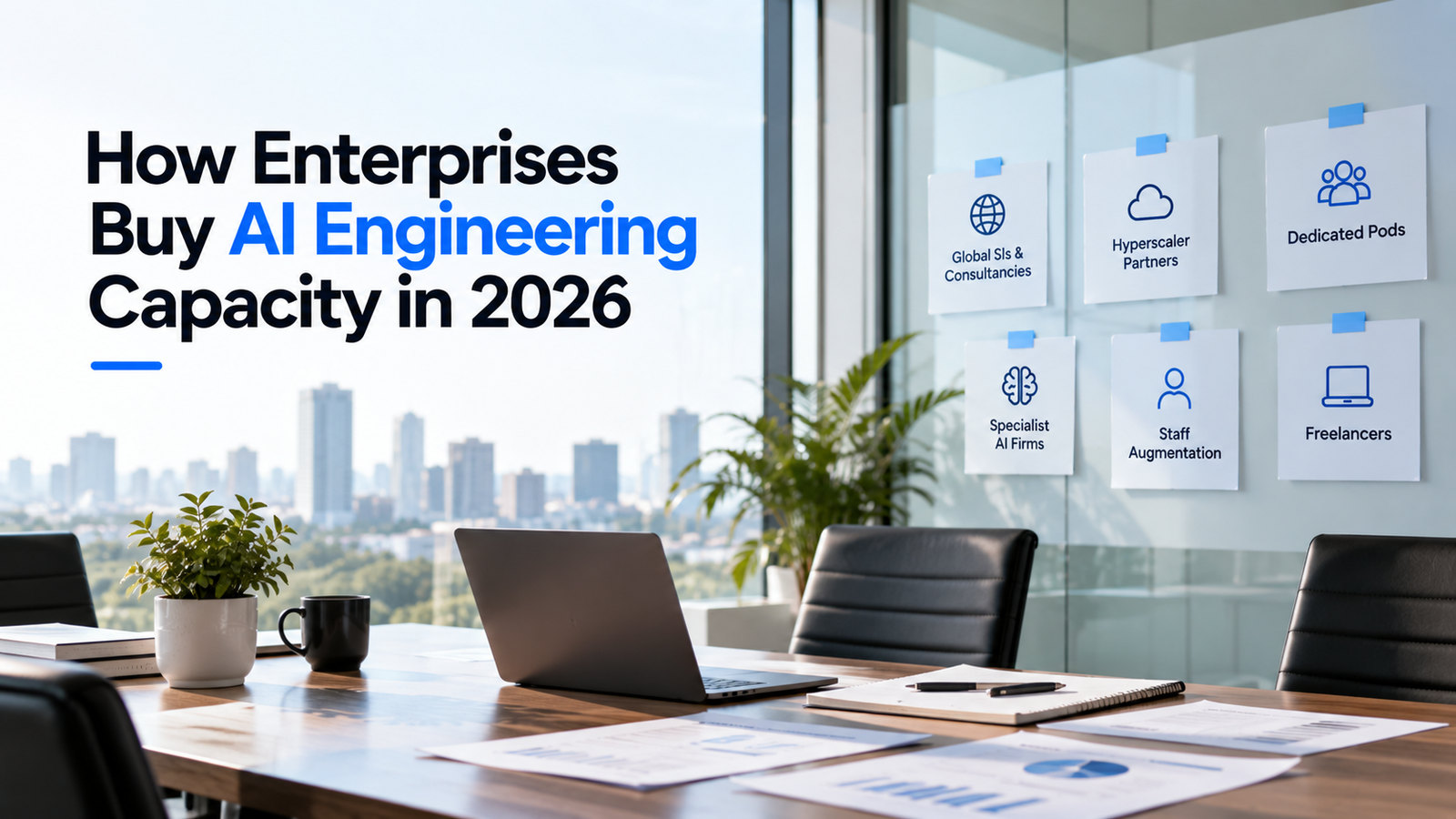
Enterprises buy AI engineering capacity through six main channels: global systems integrators, hyperscaler partners, specialist AI firms, dedicated pods or forward deployed teams, staff augmentation, and freelancers. Whichever channel you choose, an AI implementation partner has to clear the same gates: security review, vendor risk, MSA and SOW, a data processing agreement, IP terms, and a scoped pilot.
This post covers the buying mechanics rather than vendor selection. It is part of our AI strategy: pilot to production series.
What changed about enterprise AI buying in 2026?
Three data points explain why procurement is seeing more AI vendor requests.
- Services spend is large and growing. Gartner's September 2026 forecast puts worldwide AI services spending at about $576.5 billion in 2026, up from about $434 billion in 2025.
- Projects are getting smaller and more specific. In the same release, Gartner's John-David Lovelock said enterprises are "turning to service providers less often to help them manage the business transformation, and more often for the smaller indirect projects to exploit AI features of their incumbent software system."
- Buying beats building for most use cases. Menlo Ventures' survey of roughly 500 US enterprise decision-makers found that 76% of AI use cases were purchased rather than built internally in 2025, up from 53% purchased in 2024.
Scale is also rising. McKinsey's 2026 State of AI survey (1,719 respondents, fielded May to June 2026) found that 44% of respondents say AI is scaling across their enterprise, up from 38% a year earlier. Among organizations with more than $1 billion in revenue, the share scaling agents in one or more functions rose from 27% to 40%.
For procurement, that means more AI requests, each narrower in scope.
What are the six channels for buying AI engineering capacity?
Each channel has its own contract shape, and that shape decides who is accountable when a model underperforms.
| Channel | Typical contract shape | Who owns the delivery outcome | Best fit | Watch-outs |
|---|---|---|---|---|
| Global SIs and consultancies | Existing MSA, new SOW; often fixed-scope or milestone-based | The firm, through its program management | Multi-country programs, heavy change management, ERP-adjacent AI | Senior people sell, junior people deliver; change orders add up |
| Hyperscaler partners (AWS, Microsoft, Google Cloud) | Partner SOW, sometimes bought through the cloud marketplace or tied to cloud commitments | The partner, within that cloud's services | Workloads already committed to one cloud | Architecture tends to follow the partner's platform, not your needs |
| Specialist AI firms | Project SOW, fixed-fee or time and materials | The firm, for a defined deliverable | A bounded build: a RAG system, an agent, an evaluation harness | Handover quality; who maintains it after go-live |
| Dedicated AI pods / forward deployed engineers | Monthly or quarterly capacity SOW with outcome goals | Shared: vendor owns engineering execution, you own product direction | Ongoing roadmap work where requirements will change | Needs a named internal product owner to work well |
| AI staff augmentation services | Rate card per person, time and materials | You. The vendor supplies people, not outcomes | Filling specific seats inside a team you already manage | Management load stays with you; knowledge leaves with the contractor |
| Freelancers | Individual contractor agreements or a marketplace | You | Short spikes, prototypes, specialist reviews | Often fails vendor-risk and security review for production data access |
Hyperscaler partner status means something specific. AWS says its AI Competency partners are validated for "proven expertise, field experience, and successful projects." Microsoft's Azure specializations require partners to meet qualification requirements and then pass an audit, with audits or customer references revalidated every other year. Those badges show cloud expertise, not that the vendor can ship your use case.
The contract shapes behind each of these channels, and who carries the overrun risk in each, are set out in our guide to AI development engagement models. The pod and staff augmentation rows differ mostly in who owns the result: a dedicated pod is accountable for an outcome, while team augmentation supplies people into a team you manage.
What does an AI implementation partner own, and what stays with you?
An AI implementation partner is an outside firm contracted to design, build, and deploy AI systems into your production environment, not only to advise on them. What separates a good engagement from a stalled one is usually how clearly ownership was split before kickoff.
| Area | Partner owns | Your team owns | Agree explicitly |
|---|---|---|---|
| Problem and success metric | Challenging vague goals, proposing measurable ones | Final definition of the business outcome | The pilot's pass/fail criteria |
| Data access | Working within the access granted, documenting what was used | Granting access, classifying data, approving sources | Which environments and which data classes are in scope |
| Architecture and model choice | Recommending and justifying the stack | Approving against your standards and cloud commitments | Model providers, hosting region, and fallback options |
| Engineering and evaluation | Code, tests, evaluation sets, prompts, infrastructure as code | Reviewing and accepting deliverables | What "done" means, including evaluation thresholds |
| Security and compliance | Following your controls, reporting incidents | Setting controls, running audits | Incident notice windows, sub-processor approvals |
| Production operations | Handover documentation, runbooks, and support during the warranty or run period | Long-term ownership, on-call, budget for model usage | When and how ownership transfers |
If a vendor cannot place an item in a column, expect scope disputes.
What does the enterprise procurement path look like, step by step?
Most large organizations run a version of this sequence.
1. Intake and sourcing
A business sponsor raises the request and procurement checks whether a supplier on the preferred vendor list can do the work. Incumbents win often because a systems integrator with a live MSA can start under a new SOW while a new vendor is still onboarding. If you want a new supplier, write down why the incumbent does not fit.
2. NDA and early technical conversations
A mutual NDA lets the vendor see enough of your architecture and data to scope honestly. Vendors that quote a fixed price before seeing your data are guessing.
3. Security review
Expect a standardized questionnaire such as the Shared Assessments SIG, in its full Core or shorter Lite form, and a request for a SOC 2 report or ISO/IEC 27001 certificate. For AI work, add questions generic questionnaires miss:
- Which model providers and APIs will touch our data, and under which retention terms?
- Will any of our data, prompts, or outputs be used to train models?
- Where is data processed and stored, including logs and evaluation sets?
- How is access to our environments granted, logged, and revoked for offshore engineers?
4. Vendor risk and third-party risk management
The TPRM team checks financial stability, sanctions, insurance, sub-processors, and concentration risk. The NIST AI Risk Management Framework gives a reference point: GOVERN 6 calls for "policies and procedures... to address AI risks and benefits arising from third-party software and data and other supply chain issues," including contingency processes for failures in high-risk third-party AI systems.
5. MSA and SOW
The MSA sets durable terms: liability caps, indemnities, confidentiality, termination, governing law. The SOW sets the work: scope, team, milestones, acceptance criteria, rates, change control. For AI work, make acceptance criteria measurable, for example evaluation pass rates on an agreed test set.
6. Data processing agreement
If the vendor will process personal data on your behalf, EU and UK GDPR require a controller-processor contract. The UK's Information Commissioner's Office lists the minimum terms from Article 28(3): processing only on documented instructions, confidentiality, security measures, sub-processor controls, help with data subject rights and breach duties, deletion or return at the end, and audit rights. Model providers used by the vendor may count as sub-processors, so list them.
7. IP and legal terms
Legal will want assignment of the work product, clear treatment of the vendor's pre-existing tools, disclosure of open-source components, and a position on who owns fine-tuned weights, prompts, and evaluation datasets. When engineers sit in another country, local law affects how that assignment works.
This section is general information, not legal advice. Involve your counsel.
8. Pilot scoping
A pilot that gets approved has a fixed duration, a named internal owner, production-like data, and an exit decision agreed in advance: scale, change, or stop. A pilot without exit criteria tends to become an indefinite proof of concept.
How long should an enterprise expect the buying process to take?
There is no reliable industry benchmark. Duration depends on your procurement office's service levels, the vendor's risk tier, and whether personal or regulated data is in scope. What is predictable is where time goes.
| Step | Can run in parallel with | Common cause of delay | How to shorten it |
|---|---|---|---|
| Security review | Vendor risk, MSA drafting | Vendor answers questionnaires slowly or has no third-party report | Ask for the vendor's completed questionnaire and reports on day one |
| Vendor risk / TPRM | Security review | Missing financials, unclear sub-processor list | Request sub-processor and model-provider list up front |
| MSA redlines | Security, SOW drafting | Liability caps and IP indemnity | Start from your paper; flag AI-specific clauses early |
| DPA | MSA | Cross-border transfer mechanism not agreed | Decide on data residency before legal starts |
| SOW and pilot scope | Everything above | Vague success metrics | Write pass/fail criteria before the SOW goes to legal |
The critical path is usually security review plus MSA redlines. If the vendor already holds an MSA with you, the path collapses to a SOW, so ask first whether you can buy under an existing agreement.
Which channel should you route the request through?
This is a routing question, not a vendor ranking.
- You need it under an existing contract this quarter: check current systems integrators and cloud partners first, and accept you may pay for procurement speed.
- The scope is fixed and bounded: a specialist AI firm on a project SOW is usually the cleanest contract.
- The roadmap will change as you learn: a dedicated pod or forward deployed engineers under a capacity SOW, with outcome goals rather than fixed deliverables.
- You have strong engineering management and one or two missing skills: staff augmentation, knowing you own delivery.
- You need a second opinion or a two-week prototype: a vetted freelancer, kept away from production data.
- The direction itself is unsettled: a short AI consulting engagement before any build contract.
Also decide before signing whether you want an outsourced AI engineering team for the long run or a handover to internal staff. It changes the knowledge-transfer terms in the SOW, and if the answer is "we will own this eventually", start reading how to hire AI engineers while the pilot runs.
What mistakes stall enterprise AI purchases?
- Routing it like a software license. A SaaS approval path does not cover engineers working inside your data. Treat it as a services engagement.
- Skipping the model-provider question. The vendor's tooling may send data to an API your security team never reviewed.
- Buying people when you needed outcomes, or the reverse. Staff augmentation rarely includes acceptance criteria; outcome contracts rarely let you direct individual engineers.
How fwdpod approaches this
Fwdpod builds dedicated AI engineering pods for startups and enterprises, covering LLM development, RAG systems, AI agents and product delivery, for buyers in the US, UK, EU and the Gulf, with engineering delivery from India. That puts it in the pods row above: engineering execution owned by the pod, product direction owned by your team.
If you are routing a request for an AI engineering team, the pod catalogue shows how the pre-assembled pods are structured, configure your AI engineering pod returns a proposal for your own use case, and you can talk to the team about pricing and start dates.
Frequently Asked Questions
What is an AI implementation partner?
An AI implementation partner is an external firm contracted to design, build, and deploy AI systems into your production environment, rather than only advising on strategy. It can be a systems integrator, a specialist AI firm, or a dedicated engineering pod. The contract should state which outcomes the partner owns and which stay with your team.
Can we buy AI engineering capacity through our cloud marketplace?
Sometimes. Some hyperscaler partners list professional services in cloud marketplaces, and some enterprises can apply marketplace purchases against existing cloud commitments. Check with your cloud account team and procurement whether a specific partner's services are listed and eligible under your agreement.
Do we need a data processing agreement if the vendor only writes code?
If the vendor's engineers can access personal data at any point, including in logs, test datasets, or production debugging, you likely need one under EU or UK GDPR. If they work only with synthetic or anonymized data, the position may differ. Your privacy team or counsel should make that call.
Should the pilot be a separate contract from the main engagement?
Many enterprises sign the MSA once and put the pilot in its own short SOW, with a second SOW for the scale-up phase. This keeps the legal review to one pass while giving you a clean decision point after the pilot.
Is staff augmentation cheaper than a managed AI engineering team?
The rate per person can be lower, but the comparison is incomplete. With staff augmentation you carry the management, architecture, and delivery risk yourself. With a managed team some of that sits with the vendor. Compare total cost including your internal management time, not rate cards alone.
What should a security team ask that a standard vendor questionnaire misses?
Ask which model providers will process your data, whether any data or outputs are used for model training, where prompts, logs, and evaluation sets are stored, and how engineer access to your environments is granted and revoked. Standard questionnaires often predate these AI-specific risks.
Who should own the budget for model API usage during a pilot?
Agree it in the SOW. Some vendors pass usage through at cost, and others expect you to supply your own API accounts. Running the pilot on your own accounts gives your security team visibility and avoids a migration when the system moves to production.