How to Hire AI Engineers in 2026: Roles, Screening, Red Flags
How to hire AI engineers in 2026: define the role, source talent (including India), run a RAG and evals take-home, ask the right questions and spot red flags.
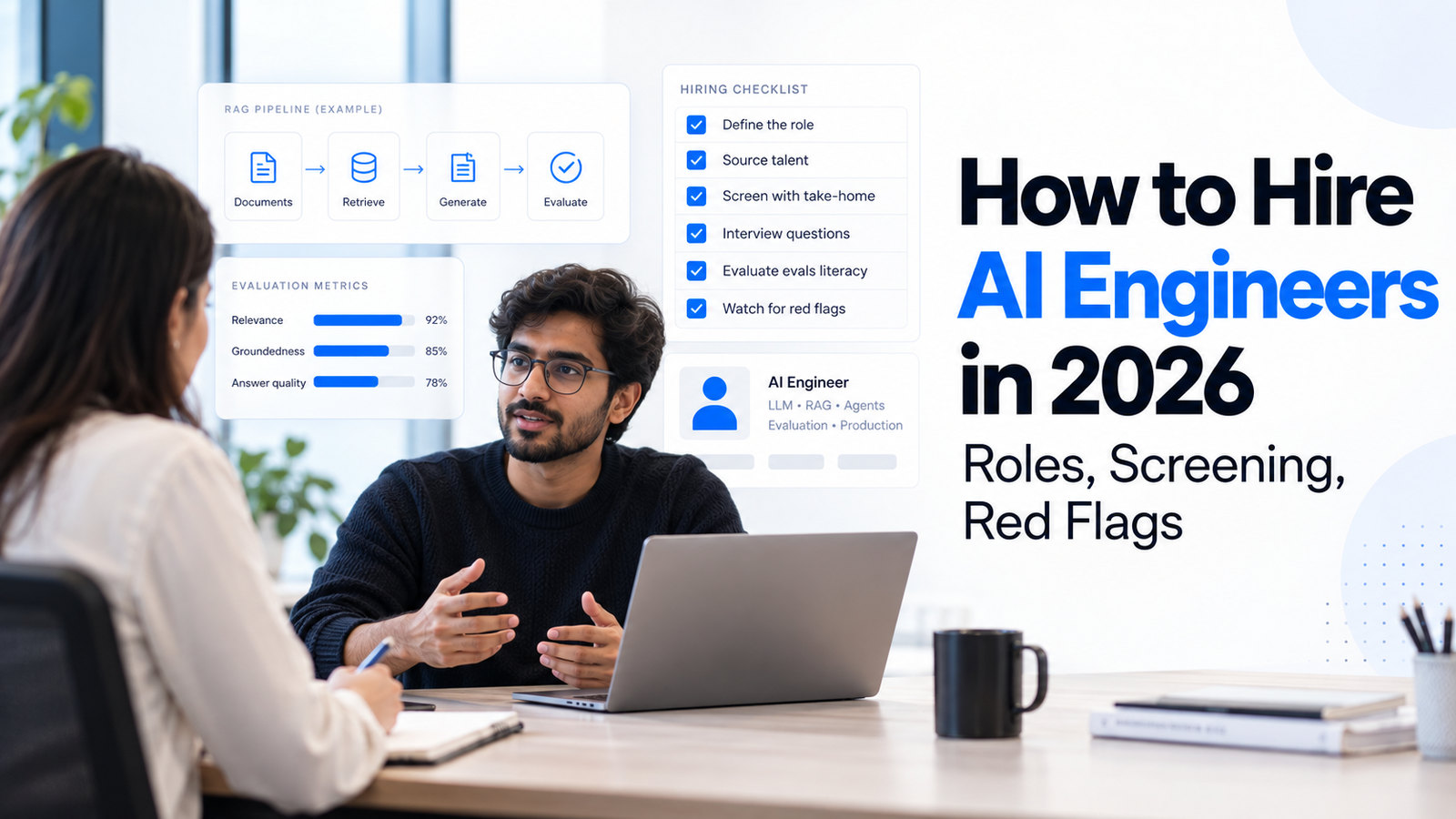
To hire AI engineers well in 2026, define the job first: most companies need someone who ships products on foundation models, not someone who trains them. Then source widely (India is now one of the largest pools), screen with a take-home on a real retrieval and evaluation problem, and test evals literacy in every round.
This guide covers each step, plus interview questions, red flags, timelines, and when hiring one engineer is the wrong answer. It is part of our AI Pods & Engineering Teams series.
What is an AI engineer, and how is it different from an ML engineer or data scientist?
An AI engineer builds applications on top of existing foundation models: prompting, retrieval, tool use, evaluation, and the software around them. An ML engineer trains, tunes and serves models. A data scientist answers questions with data and statistics. The titles overlap in job ads, which is exactly why hiring goes wrong.
Chip Huyen, author of AI Engineering, puts the distinction plainly: AI engineering "is less about model development, and more about adapting and evaluating models," and "ML knowledge is no longer a must-have for building AI applications," although it still helps when things break.
| Role | Core job | Typical outputs | Hire this role when |
|---|---|---|---|
| AI engineer | Build product features on foundation models (LLM APIs or open-weight models) | RAG pipelines, agents, eval suites, prompt and retrieval tuning, production services | You want an AI feature in front of users and the model already exists |
| ML engineer | Train, fine-tune, optimize and serve models | Training pipelines, fine-tuned models, inference infrastructure | Off-the-shelf models do not meet quality, cost or latency needs |
| Data scientist | Analyze data, run experiments, build statistical models | Analyses, forecasts, A/B test readouts, classical ML models | The question is "what does our data say?" rather than "ship a feature" |
If your first project is a support assistant, internal knowledge search or document processing, you almost certainly need an AI engineer first. Specialist splits between LLM development, RAG systems and AI agents matter once the team grows.
What should you define before you write the job ad?
Write a one-page scorecard before anyone talks to a recruiter. It forces the hiring manager to define "good" and gives every interviewer the same yardstick. It should answer five questions:
- What will this person ship in six months? For example, "a retrieval assistant over our policy documents, answering with citations, used by the support team."
- What is the stack? Hosted model APIs, open-weight models on your own infrastructure, or both.
- What data will they touch, and how clean is it? Scattered PDFs and permission-locked file shares can stall even a strong engineer for months.
- How will quality be measured? If nobody can answer, the hire will be judged on demos, which rewards the wrong people.
- Who do they work with? A lone AI engineer with no product owner or domain experts is a common failure pattern.
The scorecard also sets seniority. A first AI hire should be senior enough to make architecture calls and say no to bad ideas; a fourth hire into an existing team can be more specialized.
Where do you find AI engineers to hire?
Good AI engineers are easier to find through their work than their resumes: open-source contributions to retrieval, agent or eval libraries, technical writing that shows real trade-offs, and talks where they explain what failed. Practical channels:
- Referrals from engineers you trust, still the highest signal per hour.
- Contributors to the frameworks your stack uses.
- Backend engineers who have shipped one or two LLM features. They already understand latency, reliability and APIs; the model-specific skills are learnable.
- International talent markets, via direct hiring, an employer of record, or a vendor.
- Pods and delivery partners, when you need a team rather than a person.
Should you hire AI engineers in India?
India is now one of the largest pools of software and AI talent, and the numbers have moved quickly:
- GitHub's 2025 developer report counts 21.9 million developers in India on the platform, up from 4.5 million in 2020, ranked #2 globally. India added more than 5.2 million developers in 2025 alone, and GitHub projects India will reach 57.5 million developers by 2030.
- Citing the Stanford AI Index 2025, the Government of India reports that India "leads the world in AI talent acquisition, with an annual hiring rate of about 33%" and ranks among the top countries for AI skill penetration.
- A Deloitte and Nasscom study put India's AI talent pool at 600,000–650,000 professionals in 2022, projected to exceed 1.25 million by 2027, while warning of a "demand-supply gap in the talent pool."
Read those numbers carefully. A large pool is not a large pool of people who have shipped production LLM systems; that subset is small everywhere, so the same screening bar applies regardless of location.
If you hire AI engineers in India, settle four things early: the legal route (your own entity, an employer of record, or a vendor), working-hour overlap, the candidate's contractual notice period (it can add weeks or months to the start date), and how IP and data access are handled. Salary figures are deliberately left out here, because rates vary widely by seniority and engagement model.
What does a good AI engineer screening process look like?
A good process tests what the job actually requires: building a reliable system on a non-deterministic model and proving it works. Keep it to four stages.
| Stage | What it tests | Suggested length | Pass signal |
|---|---|---|---|
| 1. Technical screen | Real experience vs. tutorial experience | 45 min call | Talks about a shipped system, its failure modes and what they changed |
| 2. Take-home (paid if over ~4 hours) | Building, judgment, evals | 3–4 hours of work | Working code plus an honest write-up of where it fails |
| 3. System design | Architecture, cost, latency, security | 60 min | Asks about data, users and quality targets before drawing boxes |
| 4. Take-home review + team fit | Depth, ownership, communication | 60–90 min | Defends choices, accepts critique, proposes next steps |
The take-home: a small RAG and eval problem
Give candidates a realistic, bounded task: here are 40 sanitized policy documents and 20 questions employees actually asked. Build a retrieval-augmented answering service that cites its sources, plus an evaluation showing how often it is right. Grade:
- Chunking and retrieval choices, and whether they explain why.
- Refusal behavior. Does it say "I don't know" when the answer is not in the documents?
- The eval. A labeled test set, a grading method, a reported number. Anthropic's documentation lists code-based, human and LLM-based grading, calling LLM-based grading "fast and flexible" but advising you to test its reliability before scaling. A candidate who never checks an LLM judge against human labels is showing you a habit.
- The write-up. The best list known failures; the weakest claim it "works well."
The system design round
Use a problem close to your roadmap, such as an assistant answering customer questions from help-center and order data. Strong candidates ask about data freshness, permissions, traffic, acceptable error rates and cost per query before drawing anything. Then push on a failure: "It starts citing a deprecated policy. How do you find out, and fix it?"
Evals literacy, in every round
If you test only one thing, test this. Evaluation matters even more with foundation models because open-ended outputs have many valid answers. A strong candidate can explain how they build a test set, which metrics fit the task, how they catch regressions after a model or prompt change, and when a human must review outputs.
Which interview questions reveal a strong AI engineer?
Use open questions tied to real work. What a good answer contains matters more than the wording.
- "Walk me through an LLM feature you shipped. What broke in the first month?" Good: specific incidents and fixes. Weak: only the architecture diagram.
- "How did you know it was good enough to launch?" Good: a test set, a threshold, a sign-off owner. Weak: "users liked it."
- "Retrieval returns the right document but the answer is still wrong. What do you check?" Good: context assembly, chunk boundaries, conflicting sources, model limits.
- "When would you fine-tune instead of improving retrieval or prompts?" Good: a trade-off discussion covering cost and data; fine-tuning is not the default.
- "A model provider ships a new version. What happens in your system?" Good: pinned versions, an eval run before switching, a rollback plan.
- "How do you stop the system leaking data a user shouldn't see?" Good: permission-aware retrieval, not just prompt instructions.
- "Tell me about a time you told a stakeholder an AI feature was a bad idea." Good: they have done it and can explain how.
For agent-heavy roles, add questions on tool design, loop limits and human approval steps.
What are the red flags when hiring AI engineers?
Skill and honesty red flags:
- Every project is a demo or hackathon build; nothing ran for real users.
- Evaluation means "I tried some prompts."
- Proposes fine-tuning before asking about the data or the goal.
- Cannot explain what their framework does under the hood, so they will stall the first time the abstraction leaks.
- Treats prompt instructions as a security boundary.
- A take-home write-up with no known failure modes, or code they cannot explain or modify live.
- A resume listing every model and framework released in two years, with vague answers about their own role.
Identity and fraud red flags. This is no longer hypothetical. In July 2025 Gartner predicted that by 2028 one in four candidate profiles worldwide could be fake; 6% of 3,000 candidates it surveyed admitted to interview fraud. The FBI has warned US employers that North Korean IT workers obtain remote jobs and in some cases steal data and extort companies, noting AI face-swapping in video interviews. It advises identity verification "during interviewing, onboarding, and throughout the employment of any remote worker," checking resumes for reused phone numbers and emails, and doing as much hiring in person as possible. Verify identity before granting access to code or data, and ask vendors how they verify theirs.
How long does it take to hire an AI engineer?
Expect a full cycle of well over a month before an offer is signed, and longer before the person starts. Ashby's 2026 startup hiring report found average time to hire at startups under 25 employees was 42 days with a recruiter involved versus 62 days without. That figure covers all roles, not AI specifically, and senior AI engineers are a narrower pool than most.
| Phase | What drives the duration |
|---|---|
| Scorecard and job ad | Internal agreement on the role; skipping it causes restarts |
| Sourcing | Seniority, location flexibility, referrals |
| Interview loop | Scheduling, take-home turnaround, decision speed |
| Offer | Competing offers, approval chains |
| Notice period | The candidate's current contract; can exceed everything above |
| Ramp-up | Access to data, systems and domain experts |
The cheapest fixes are internal: a finished scorecard, a ready take-home, calibrated interviewers, and a decision within 48 hours of the final round.
When does hiring an AI pod make more sense than hiring engineers?
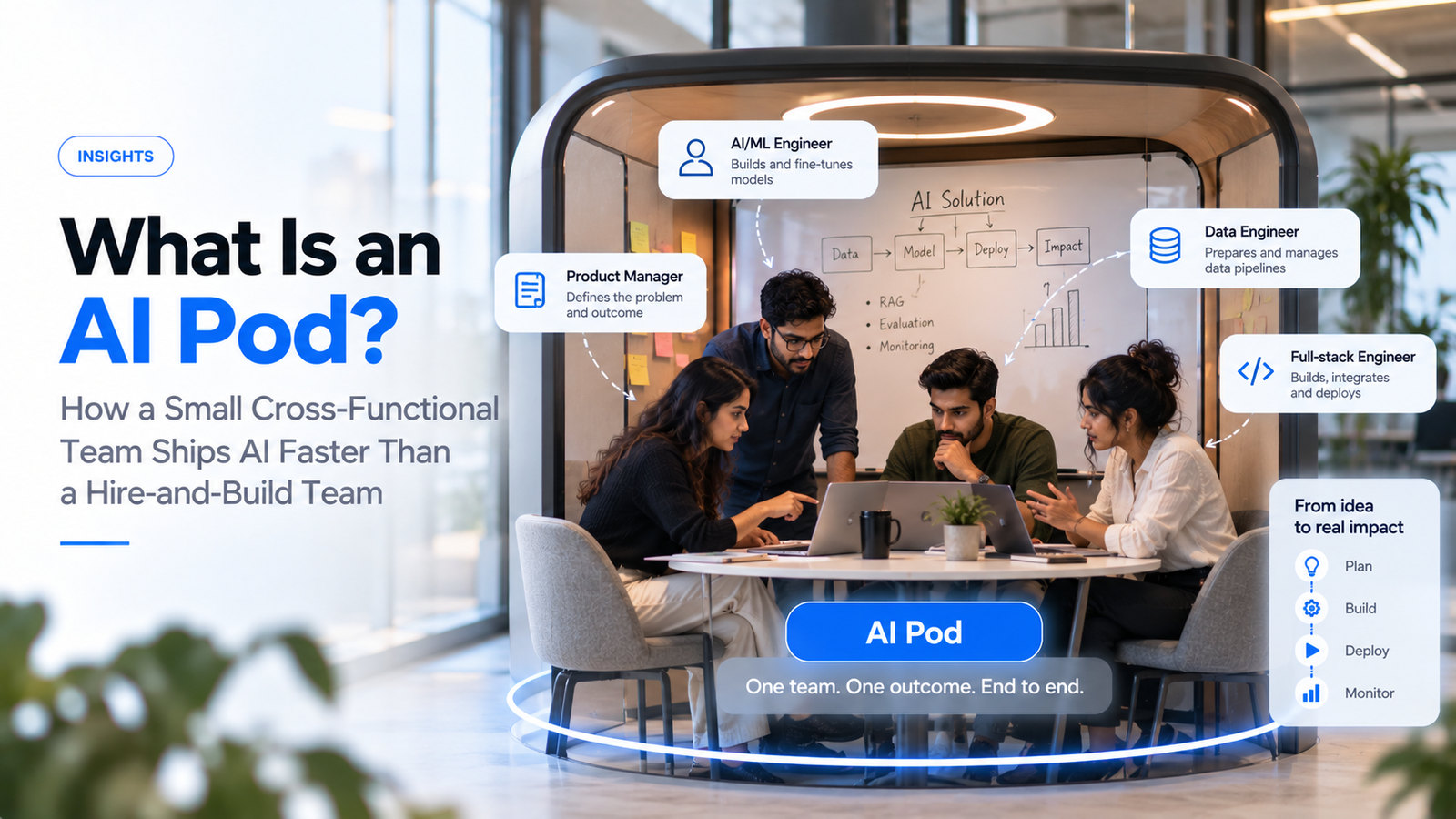
Hiring individuals is right when AI is a long-term core capability, you have a strong technical lead, and you can wait out the cycle. It is often wrong when you need several skills at once (AI, data, backend, product) for one project, need to start before a hire would land, have nobody who can run the screening above, or do not yet know whether you need a permanent team.
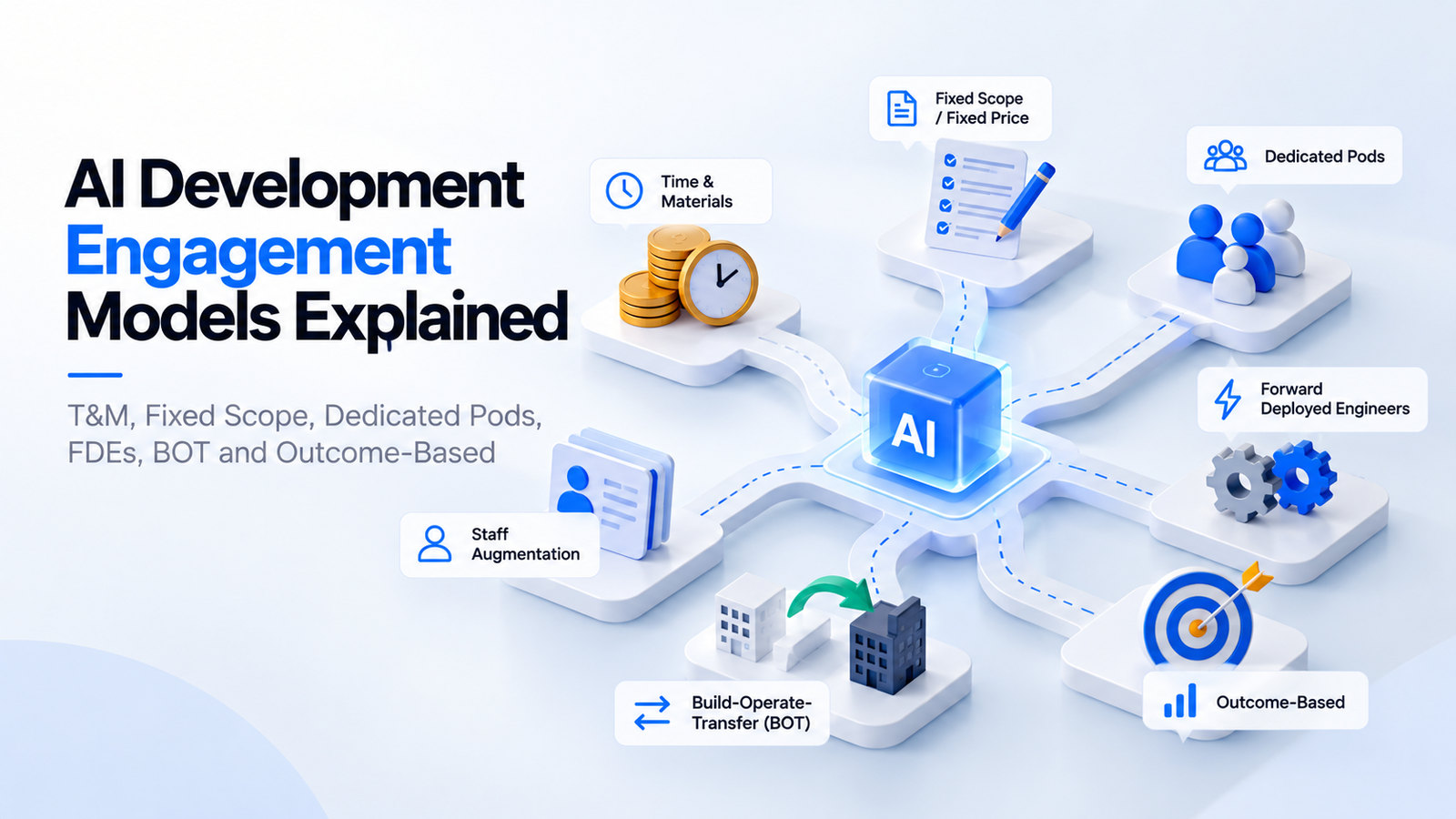
In those cases a dedicated AI engineering pod, a small cross-functional team from a delivery partner, lets you ship the first system while you decide on permanent structure. If you only need extra hands around an existing AI lead, team augmentation is the narrower option. The two also combine: a pod builds the first production system while you hire in parallel, with the pod helping define the role and run technical screens.
How Fwdpod approaches this
Fwdpod builds dedicated AI engineering pods for startups and enterprises, covering LLM development, RAG systems, AI agents and product delivery, with engineering delivered from India for buyers in the US, UK, EU and the Gulf.
If you are weighing a hire against a pod, the pod catalogue shows how each pod is put together, or configure your AI engineering pod to get a proposal for your own use case. For pricing, talk to the team.
Key takeaways
- Decide between AI engineer, ML engineer and data scientist before posting.
- Write a scorecard with six-month outcomes and a quality measure.
- Source through work; India's pool is large, but production experience is scarce everywhere.
- Screen with a bounded RAG-plus-eval take-home and a system design round, and make evals literacy non-negotiable.
- Verify identity before granting access.
- Consider a pod when you need a team now.
Frequently Asked Questions
What skills should an AI engineer have in 2026?
Strong software engineering fundamentals, hands-on experience with LLM APIs or open-weight models, retrieval design, evaluation and testing, cost and latency optimization, and data security basics such as permission-aware retrieval. Deep model-training expertise is useful but not required for most application roles.
Do AI engineers need a PhD or machine learning degree?
No, for most product roles. AI engineering focuses on adapting and evaluating existing models rather than training new ones. A research background matters more for ML engineering or model-training roles.
Should the take-home assignment be paid?
Pay for it if it takes more than about four hours. Paying signals respect, improves completion rates among senior candidates who have several options, and lets you ask for a more realistic task.
Can I hire a single AI engineer to build our first AI product?
You can, but one person rarely covers data pipelines, backend integration, evaluation and product decisions alone. A solo hire works best when strong backend and data support already exists inside the company.
How do I verify a remote AI engineer's identity?
Use identity verification during interviews and onboarding, cross-check resumes and contact details, ask specific questions about location and education, and complete as much of the process in person as you can. These steps follow the FBI's January 2025 guidance for employers.
Is it better to hire AI engineers directly in India or through a vendor?
Direct hiring needs a legal route such as your own entity or an employer of record, plus your own screening capacity. A vendor or pod handles employment and often screening, in exchange for less direct control. The right choice depends on how permanent the team is meant to be.
What is the difference between an AI engineer and a prompt engineer?
Prompt writing is one task inside AI engineering. An AI engineer also builds retrieval, integrates tools and data, writes evaluations, and runs the system in production. Most companies now hire for the broader role.