AI Development Engagement Models Explained: Who Carries the Risk, and When Each One Fits
AI development engagement models explained: T&M, fixed scope, dedicated pods, staff aug, FDEs, BOT and outcome-based, with risk and contract clauses for each.
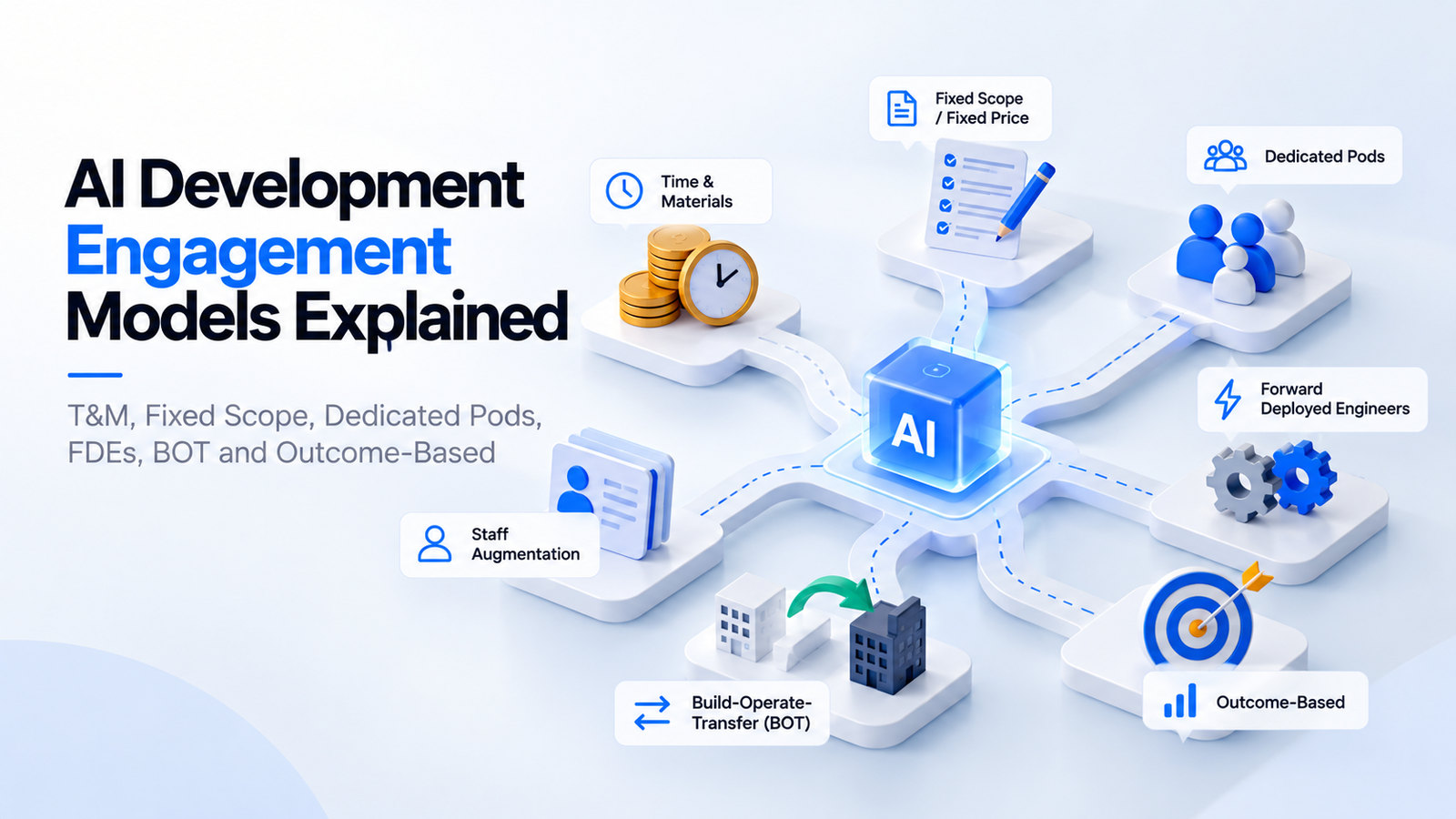
AI development engagement models explained in one line: each model decides who pays when the work turns out harder than expected. Time and materials puts that risk on you, fixed scope puts it on the vendor, and retainers, pods, forward deployed engineers, build-operate-transfer and outcome-based deals split it in different ways. The right choice depends on how much of your AI project is still unknown.
That last point matters more for AI than for ordinary software. A CRUD app can be specified up front. An LLM feature usually cannot, because nobody knows how good the output will be on your data until someone builds a baseline and measures it. This hub, part of our AI pods and engineering teams series, covers seven models, and for each one: how it works, where the risk sits, when it suits AI work, and the contract clauses worth reading twice. It does not cover prices; for that, talk to the team.
The seven models at a glance
| Model | What you pay for | Who carries overrun risk | Best fit for AI work | Clause to read twice |
|---|---|---|---|---|
| Time and materials (T&M) | Hours or days worked, at agreed rates | Mostly you | Discovery, prototypes, unclear data | Ceiling and burn reporting |
| Fixed scope / fixed price | A defined deliverable | Mostly the vendor | Well-specified, measurable pieces | Acceptance criteria and change control |
| Monthly retainer / dedicated pod | A team's capacity for a period | Shared | Evolving roadmap, build then iterate | Named people and replacement terms |
| Staff augmentation | Individual engineers' time | You | Adding hands to a team that already knows AI | IP assignment and replacement SLA |
| Forward deployed engineers | Engineers embedded with your users | Shared, weighted to vendor on integration | Messy workflows, hard integrations | On-site access, data handling, exit |
| Build-operate-transfer (BOT) | Setup, operation, then transfer of a team | Vendor early, you later | Long-term offshore capability | Transfer trigger, fee and employee terms |
| Outcome-based | A measured business result | Vendor (if written properly) | Mature, measurable use cases | Outcome definition and measurement |
The sections below explain each row.
Why do engagement models matter more for AI projects?
Three features of AI work break the assumptions most software contracts are built on.
"Done" is a score, not a checklist. An LLM system is accepted when its outputs clear an agreed bar on a representative test set. Anthropic's guidance says success criteria should be specific, measurable, achievable and relevant, and that evaluations should "mirror your real-world task distribution" including edge cases. You often cannot know what score is achievable until a baseline exists.
The foundation moves under you. Hosted models are retired on the provider's schedule. OpenAI's deprecation policy promises at least six months' notice for generally available models, while preview models may be retired with much shorter notice, such as two weeks. A contract signed against one model version may be delivered against another.
Many projects stop at the pilot. In July 2024 Gartner predicted that at least 30% of generative AI projects would be abandoned after proof of concept by the end of 2025, citing poor data quality, inadequate risk controls, escalating costs and unclear business value. An engagement model with no cheap exit point turns a sensible "stop" into a sunk-cost argument.
So the practical question is not "which model is best?" but "which model matches the amount of uncertainty left in this phase?"
How does time and materials work for AI development?
How it works. You pay for hours or days worked at agreed rates, plus pass-through costs such as cloud and model usage. Scope can change weekly without renegotiation.
Risk allocation. The buyer carries overrun risk. US federal procurement rules put it bluntly: a time-and-materials contract "provides no positive profit incentive to the contractor for cost control or labor efficiency," so the buyer must actively monitor performance, and the contract must include a ceiling price that the contractor exceeds at its own risk (48 CFR 16.601). Those rules govern US government contracting and do not bind private deals, but the logic carries over.
When it fits AI work. The same regulation allows time and materials only when it is not possible to estimate the extent or duration of the work with confidence. That describes an AI discovery phase well: data you have not profiled, a use case nobody has baselined, a model choice still open. It is a good way to buy the first few weeks of learning.
Clauses to watch. - A hard ceiling (or "not to exceed" amount) per phase, with written approval to exceed it. - Weekly burn reports tied to outputs: eval runs completed, baseline scores, open risks. - Who pays for model API and GPU usage, and whether the vendor marks it up. - A short termination-for-convenience notice, so you can stop cleanly after discovery.
When does fixed scope work for AI, and when does it backfire?
How it works. The vendor commits to a defined deliverable for an agreed price and date. Changes go through a change-request process.
Risk allocation. The vendor carries cost overruns. The federal definition of a firm-fixed-price contract says it "places upon the contractor maximum risk and full responsibility for all costs and resulting profit or loss" (48 CFR 16.202-1). In return, vendors price in a contingency, and scope becomes the battleground.
When it fits AI work. Fixed price suits work with "reasonably definite functional or detailed specifications" where performance uncertainties can be identified and costed (48 CFR 16.202-2). In AI projects, those pieces exist: building an evaluation harness, wiring a RAG pipeline to a known document store, adding monitoring to an agent that already works, or migrating prompts to a new model version. It backfires when the fixed deliverable is "an assistant that answers accurately," because accuracy is exactly the unknown.
Clauses to watch. - Acceptance defined as an eval threshold on a named, frozen test set, not "works as described." - What happens if the threshold proves unreachable after good-faith effort: a scoped fallback, a partial payment, or a switch to time and materials. - Change-control pricing, so a new data source does not reopen the whole deal. - Model substitution: whether the vendor may switch model or provider to hit the price.
What is a monthly retainer or dedicated AI pod engagement?
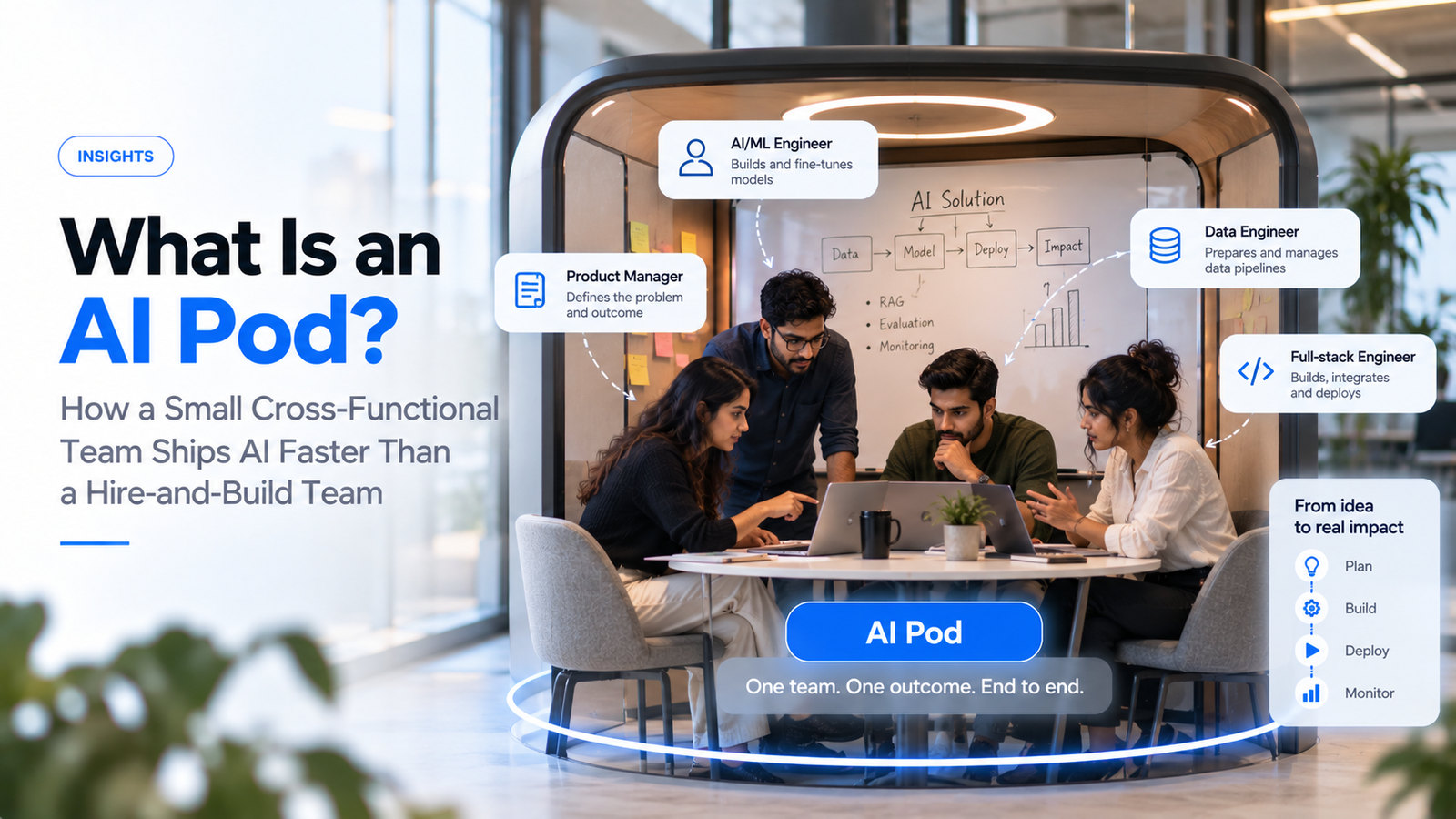
How it works. You pay a recurring fee for a team's capacity over a set term, usually a small cross-functional group with its own delivery lead. Priorities are set in regular planning; the team ships against goals rather than a fixed specification. For the anatomy of the team itself, see what an AI pod is.
Risk allocation. Shared. You carry the risk that priorities were wrong; the vendor carries the risk of staffing, replacement and delivery quality within the capacity bought. Outcome goals, if written into the statement of work, shift more of the delivery risk to the vendor.
When it fits AI work. This is the model most suited to the build-measure-adjust loop of LLM work, where the next sprint depends on what the last eval run showed. It also covers the part many contracts forget: operating the system after launch, when prompts, retrieval sources and model versions keep changing.
What is the difference between a dedicated and a shared AI pod?
A dedicated pod is assigned only to you for the term. It builds context on your data and systems, and continuity is its main benefit. A shared pod spreads one team's capacity across several clients. It suits intermittent needs, such as monthly evaluation runs or small feature requests on a live system, but response times are slower and context is thinner. When comparing proposals, ask for the percentage of each named person's time allocated to you; "shared" can mean anything from a half-time team to a help desk. The pod catalogue shows how pre-assembled pods are put together.
Clauses to watch. - Named key personnel, allocation percentage, and how much notice you get before a swap. - Minimum term and notice to scale down or exit. - Capacity rollover: what happens to unused capacity in a slow month. - Handover obligations at exit: repositories, eval sets, prompts, runbooks and a knowledge-transfer period.
How does staff augmentation work, briefly?
You rent individual engineers who work under your managers and process. You carry delivery risk; the vendor is accountable for supplying qualified people and replacing them. It fits AI work only when your team already knows how to build and run production AI and simply needs more hands, which is how team augmentation is usually bought. The clauses to check are an explicit IP assignment, a replacement window, and whether the engineers are the vendor's employees or subcontractors.
How do forward deployed engineer engagements work?
How it works. Engineers embed with your users and operators, often on-site or inside your tools, to turn a product or model into something that works in your real workflow. Palantir, which popularized the role, describes its forward deployed software engineers as engineers who embed "directly with our customers" to solve their toughest problems. Commercially, forward deployed engineering is usually sold as a retainer or a scoped deployment, sometimes bundled with a platform license. Our explainer on what a forward deployed engineer is covers the role itself.
Risk allocation. Shared, but the vendor takes on more integration risk than in a pod, because the engineer's job is to close the gap between demo and production inside your environment.
When it fits AI work. When the hard part is not the model but the context: undocumented workflows, legacy systems of record, permission models, or users who need to trust the output before they adopt it.
Clauses to watch. - Access and data handling: which systems, which data classes, from which locations. - Whether code written inside your environment is yours or part of the vendor's platform. - Travel and on-site expectations, stated up front. - An exit plan that leaves your team able to run what was built.
What is build-operate-transfer, and does it make sense for AI teams?
How it works. A provider sets up a team (often an offshore capability center), runs it for an agreed period, then transfers ownership and control to you. The Indian law firm Cyril Amarchand Mangaldas describes the model as one where a service provider builds the centre, "operates it in the initial days, and gradually transfers ownership and control" once it is self-sustaining; some variants leave the provider with a minority stake after transfer.
Risk allocation. The provider carries setup, hiring and operating risk early; you take it all on after transfer.
When it fits AI work. When you are confident AI engineering is a long-term capability you want to own, and you want production experience before you take on an entity, payroll and local compliance. It is a poor fit for a single project or an unproven use case. If the question is really about building the team yourself, see how to hire AI engineers.
Clauses to watch. - The transfer trigger (date, headcount or maturity milestone) and whether it is your option or automatic. - The transfer fee basis, agreed at signing. - Employee transfer terms under local employment law, and any non-solicit that applies before transfer. - Ownership of IP, tooling licenses and infrastructure accounts at each stage.
Build-operate-transfer involves corporate and employment law in the delivery country. This is general information, not legal advice; involve your counsel.
Does outcome-based pricing work for AI development?
How it works. The vendor is paid, fully or partly, on a measured result: tickets resolved, documents processed, hours saved. Zendesk, for example, charges per resolution only when its AI fully resolves an issue.
Risk allocation. In theory, the vendor carries the performance risk. In practice, it depends on the drafting. Gartner analyst Tom Coshow suggests buyers ask: "If the vendor isn't taking on the risk, why are you bothering with outcome-based pricing?" Gartner also reports that only 19% of services buyers use outcome-based arrangements today and calls the trend "more buzz than reality."
When it fits AI work. Late, not early. Outcome pricing needs a stable baseline, a metric both sides can observe, and enough volume to smooth out noise. That usually means a system already in production. For a first build, a hybrid works better: a capacity or fixed fee with a bonus or holdback tied to agreed eval or business metrics.
Clauses to watch. - The exact outcome definition, including edge cases (partial resolutions, escalations, reopened tickets). - Who owns and can audit the measurement data. - What happens when your own changes (a new policy, a new product line) move the metric. - A floor or cap on payments, so neither side is exposed to runaway numbers.
How do you match the engagement model to the stage of an AI project?
Most AI projects change model as uncertainty falls. A common sequence:
| Stage | Main unknown | Model that usually fits | Exit point to agree |
|---|---|---|---|
| Discovery and baseline | Is the data usable? What score is realistic? | Capped time and materials, or a short fixed-fee discovery | Go/no-go on a baseline eval result |
| Build to first production | How to reach the target score and integrate | Dedicated pod or FDE retainer, with outcome goals | Target met on the frozen eval set |
| Well-defined add-ons | Little; the work is specifiable | Fixed scope | Acceptance against written criteria |
| Run and improve | Drift, model changes, new use cases | Retainer or shared pod; outcome-linked fees if the metric is stable | Annual review; handover option |
| Long-term ownership | Whether to own the team outright | Build-operate-transfer, or hire in-house | Transfer trigger |
If the direction itself is still open rather than the contract shape, an AI consulting engagement is the cheaper first step.
Which contract clauses matter in every AI engagement model?
Whatever the model, five clauses decide whether an AI engagement ends well:
- Eval-based acceptance. Name the test set, the metric and the threshold. Freeze the test set, or agree how it may change.
- Model and provider change. Who decides when a model is deprecated or a cheaper one appears, and who pays for re-testing.
- IP and artifacts. Code, prompts, eval sets, fine-tuning data and infrastructure-as-code should be assigned to you and live in repositories you control.
- Data handling. Which data leaves your environment, which model providers see it, and retention terms.
- Exit and handover. Notice period, a knowledge-transfer window, and a list of what must be delivered on the way out.
General information, not legal advice; involve your counsel before signing.
Common mistakes when choosing an engagement model
- Fixing the price on an unknown. A fixed bid for "an accurate AI assistant" either carries a large contingency or ends in a dispute.
- Open-ended time and materials with no checkpoints. Uncapped hours plus no baseline means you learn nothing until the budget is gone.
- Calling augmentation a pod. If there are no outcome goals and no delivery lead, you are managing individuals.
- Outcome pricing before a baseline exists. You cannot share gains you cannot measure.
- No exit ramp. Every model needs a point where stopping is cheap and planned.
How fwdpod approaches this
Fwdpod builds dedicated AI engineering pods for startups and enterprises, covering LLM development, RAG systems, AI agents and product delivery, for buyers in the US, UK, EU and the Gulf, with engineering delivery from India.
To see how these options are structured commercially, browse the pod catalogue, configure your AI engineering pod for a proposal built around your own use case, or talk to the team about pricing.
Frequently Asked Questions
Which AI development engagement model is cheapest?
None is cheapest in general. Time and materials can cost least if the work turns out simple, and most if it does not. Fixed price looks predictable but includes the vendor's contingency for risk. Compare models on total cost to reach an agreed milestone, including model and cloud usage, rather than on rates.
Can an AI project start on time and materials and move to fixed price later?
Yes, and it is often the sensible order. Use a capped time-and-materials or short discovery phase to profile the data and set a baseline score, then fix the price on parts that are now well specified, such as integration or monitoring work.
How should acceptance criteria be written for an LLM deliverable?
Name a representative test set, freeze it, and set a measurable threshold on it, such as a minimum accuracy or groundedness score, plus limits on latency and cost per request. Agree in advance what happens if the threshold proves unreachable after good-faith effort.
Is a monthly retainer the same as a dedicated AI pod?
Not always. A retainer is a payment structure: a recurring fee for access to capacity. A dedicated pod is a team structure: a cross-functional team assigned only to you. Many dedicated pods are paid as retainers, but a retainer can also buy a few hours of shared advisory time.
How is outcome-based pricing different from a success fee?
A success fee is usually a one-off bonus paid when a milestone is hit. Outcome-based pricing ties ongoing payments to a measured result, such as each resolved ticket. Both need a precise, auditable definition of the outcome.
What is an AI pod vs an agency engagement?
An agency typically delivers a scoped project and hands it over at the end. A pod is usually engaged for capacity over time and keeps iterating after launch, which is why pods suit systems that need tuning once real users arrive.
What happens to our AI system if the vendor relationship ends?
That depends on the exit clause. A good contract requires the vendor to hand over code, prompts, evaluation sets, infrastructure definitions and runbooks, and to run a knowledge-transfer period. Keep repositories and cloud accounts in your name from the start so exit does not depend on goodwill.