What Is a Forward Deployed Engineer? The 2026 Definition
What is a forward deployed engineer? The 2026 definition: where the FDE role came from at Palantir, what FDEs do day to day, key skills, and the AI variant.
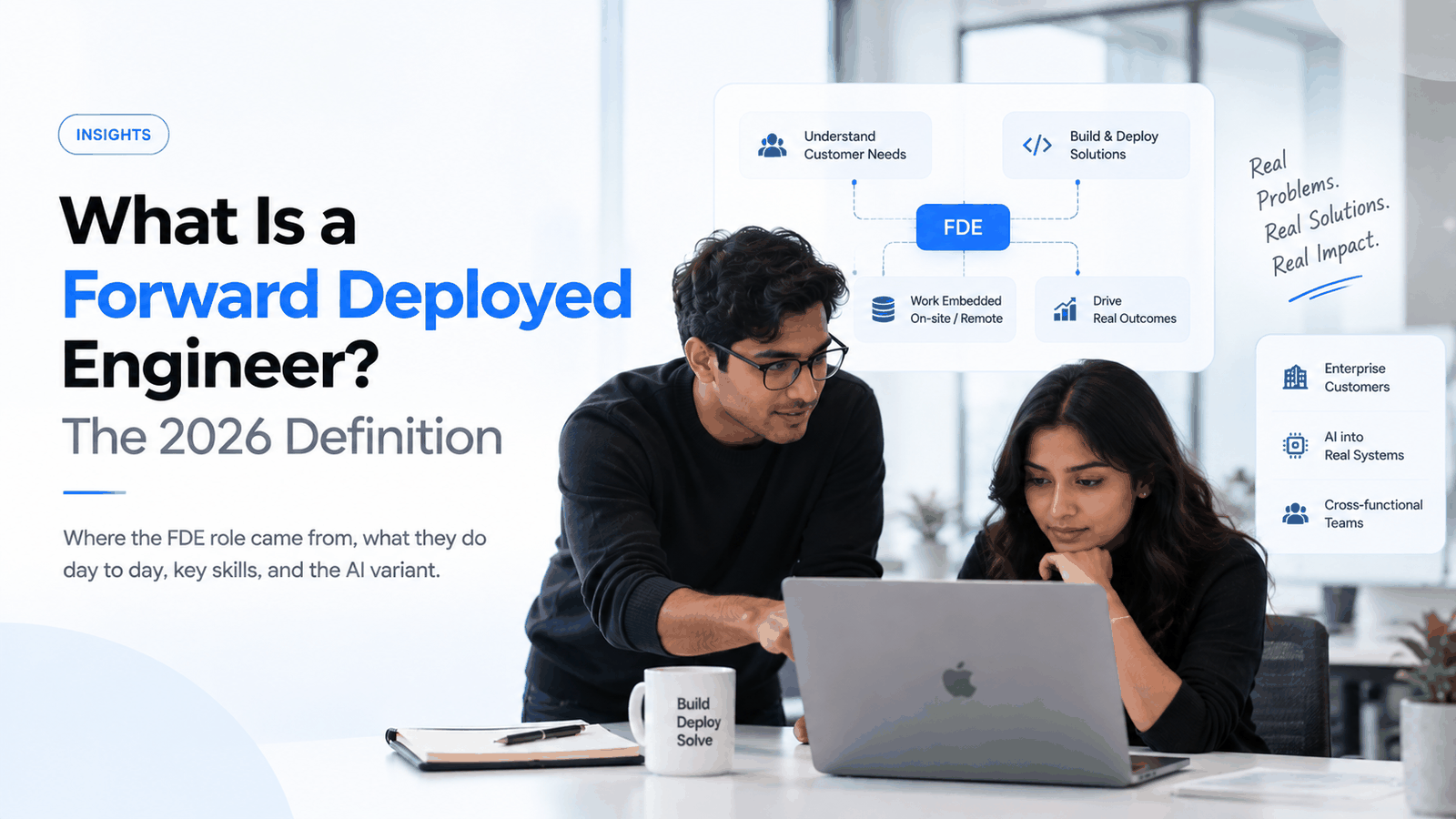
A forward deployed engineer (FDE) is a software engineer who works embedded with a specific customer, writing production code inside that customer's systems to make a product solve a real business problem. So what is a forward deployed engineer, in one line? An engineer who owns the outcome for one customer, rather than one feature for all customers.
The role started at Palantir, spread to AI labs such as OpenAI and Anthropic, and in 2026 it has become the default way companies get large language models out of the demo stage and into daily operations. This guide covers where the title came from, what the work looks like week to week, the skills it takes, and how the "forward deployed AI engineer" variant differs from the original.
The forward deployed engineer meaning, in plain terms
The forward deployed engineer meaning is easiest to grasp through a contrast Palantir itself uses. Its product engineers work on "one capability, many customers." Its forward deployed engineers work on "one customer, many capabilities".
That single sentence explains most of what makes the job distinct:
- The unit of work is a customer, not a feature. An FDE is measured on whether the customer's problem got solved, not on whether a ticket closed.
- The engineer sits "forward". The term borrows from military usage: forward deployed means stationed close to the front line. In software, the front line is the customer's data, systems, and people.
- The output is working software. FDEs write, test, and ship code. That separates them from advisory roles that stop at a recommendation or a slide deck.
- Learning flows back. What the FDE finds in the field is fed back to the product team, so the core product improves from real deployments.
A useful working definition for 2026: a forward deployed engineer is a customer-embedded software engineer who takes a product or model from first prototype to stable production inside one organization, and reports what they learn back to the people who build the product.
Where did the forward deployed engineer role come from?
The FDE title comes from Palantir, which built its delivery model around engineers who deploy its platforms at customer sites. Internally, Palantir calls these engineers "Deltas." Its official title is Forward Deployed Software Engineer (FDSE).
In a 2019 post, Palantir described the split this way: "Devs (Software Engineers) develop and engineer our software platforms, Palantir Foundry and Palantir Gotham," while "Deltas (Forward Deployed Software Engineers) deploy our software platforms to customers". The same post quotes an Abu Dhabi-based Delta who spends "a couple of days working at the customer premises" most weeks, "monitoring, debugging, deploying, or configuring our software," then returns to the office for code changes, pull request reviews, and solution planning.
A later Palantir post describes the FDSE as "a software engineer who embeds directly with our customers to configure Palantir's existing software platforms to solve their toughest problems". Note the word configure. At Palantir, Deltas mostly compose existing platform features for a customer rather than building every system from scratch.
Deltas and Echos
Palantir pairs Deltas with a second forward role: the Deployment Strategist, "known internally as 'Echo'." According to Palantir, "Echos are more product-managers while Deltas are more technical," though in practice both roles blend product, engineering, and strategy work.
This pairing matters for anyone copying the model: at Palantir, a technical engineer and a problem-framing strategist typically went in together.
How did the FDE role spread to AI companies?
The role spread because generative AI products have the same problem Palantir's platforms had: they are powerful in general and useless until they are wired into one organization's data, tools, and workflows.
2025: startups adopt the model. In June 2025, a widely read venture capital analysis of AI go-to-market argued that enterprises buying AI "want to use it, but they need you to set it up," and that AI application companies were accepting lower services margins to do that setup work. It counted 22 of OpenAI's 311 open roles at the time as FDE or solutions engineering positions.
Frontier labs build FDE teams. OpenAI now advertises dedicated Forward Deployed Engineer roles, including general and industry-specific positions such as healthcare and semiconductors. Its San Francisco posting says FDEs "lead complex end-to-end deployments of frontier models in production alongside our most strategic customers". Anthropic hires FDEs into its Applied AI team, where the role "embeds directly with our most strategic customers to drive transformational AI adoption".
2026: FDEs become a business line. On 11 May 2026, OpenAI announced the Deployment Company, backed by "more than $4 billion of initial investment," and agreed to acquire the applied AI firm Tomoro, which brought roughly 150 experienced forward deployed engineers at launch.
The spread also changed what an FDE deploys. A Palantir Delta configured a mature platform; an AI lab FDE deploys a model whose behavior is probabilistic, so the job now includes evaluation, prompt and agent design, and guardrails.
What does a forward deployed engineer actually do?
In practice, a forward deployed engineer spends most of their time on one customer's problem, moving it through a repeatable sequence from discovery to production. The exact mix changes week to week. One Palantir FDE has described weeks spent "developing and reviewing my team's code, like a typical software engineer," and other weeks "scoping the future of a project with a client".
The table below maps the typical phases of an FDE engagement to the concrete work in each.
| Phase | What the FDE does | Typical output |
|---|---|---|
| Discovery | Sits with users and operators, maps the workflow, finds where the product or model can change a number that matters | A scoped problem statement and success metric |
| Prototype | Builds a narrow working version against real (or realistic) customer data | A demo users can try on their own cases |
| Integration | Connects the prototype to the customer's systems of record, identity, permissions, and data pipelines | Authenticated, permissioned integration code |
| Hardening | Adds tests, monitoring, error handling, evaluation, and security review items | A system that passes the customer's release process |
| Production and handover | Ships, watches it under real load, trains the customer team, documents runbooks | A stable production system and an owner on the customer side |
| Feedback | Reports gaps, bugs, and repeat patterns to the product or research team | Product changes that help the next customer |
OpenAI's posting describes the same loop in its own words: "own technical delivery across multiple deployments from first prototype to stable production," "embed closely with customer teams," and "share field feedback that helps Research and Product understand where the models succeed".
Requirements are rarely written down, so the FDE often defines the problem before anyone writes a ticket. Presence matters too: OpenAI lists up to 50% travel for this role, and Anthropic estimates 25% travel to customer sites.
What skills does a forward deployed engineer need?
A forward deployed engineer needs the coding ability of a senior full-stack engineer plus the judgment to operate without a product manager nearby. Current job postings from the AI labs make the bar concrete:
- Production-grade coding across the stack. OpenAI asks for engineers who "write and review production-grade code across frontend and backend using Python, JavaScript." Anthropic asks for strong Python and ideally another language.
- Hands-on LLM experience. Both labs require experience building or deploying systems powered by LLMs. Anthropic specifically names prompt engineering and agent development.
- Customer-facing seniority. OpenAI's listing asks for 5+ years of engineering or technical deployment experience that includes customer-facing work; Anthropic asks for 4+ years in a technical, customer-facing role.
- Scoping under uncertainty. OpenAI lists the ability to scope and deliver "complex systems in fast-moving or ambiguous environments."
- Organizational navigation. Anthropic calls out "high agency with an ability to navigate ambiguity present in complex organizations," which in plain terms means getting access, approvals, and data from people who do not report to you.
- Communication. Explaining trade-offs to executives and debugging a pipeline with an analyst can happen on the same day.
Neither lab lists research credentials. FDEs apply models; they rarely train them.
What is a forward deployed AI engineer?
A forward deployed AI engineer is an FDE whose main job is putting AI systems, usually LLM applications and agents, into production inside a customer organization. It is the fastest-growing version of the role and the one most buyers mean in 2026.
The core pattern (embedded, customer-owned outcome, ships code) stays the same. What changes is the material the engineer works with:
- The deliverables are AI-specific. Anthropic's posting lists "MCP servers, sub-agents, and agent skills that will be used in production workflows" as typical FDE outputs.
- Evaluation replaces simple testing. Model output varies, so the forward deployed AI engineer builds evaluation sets from the customer's own cases and tracks quality over time.
- Context is the hard part. Retrieval over internal documents, tool access through APIs, and permission-aware data access decide whether an agent is useful. The practical work is integrating AI applications with internal databases, APIs, and workflows so models have business context.
- Model choice is a design decision. A lab FDE deploys that lab's models. An independent forward deployed AI engineer may choose between providers or open-weight models per use case.
Put simply, a forward deployed AI engineer builds like an applied AI engineer on a product team, but does it inside the customer, where a consultant would sit.
How is an FDE different from a solutions engineer?
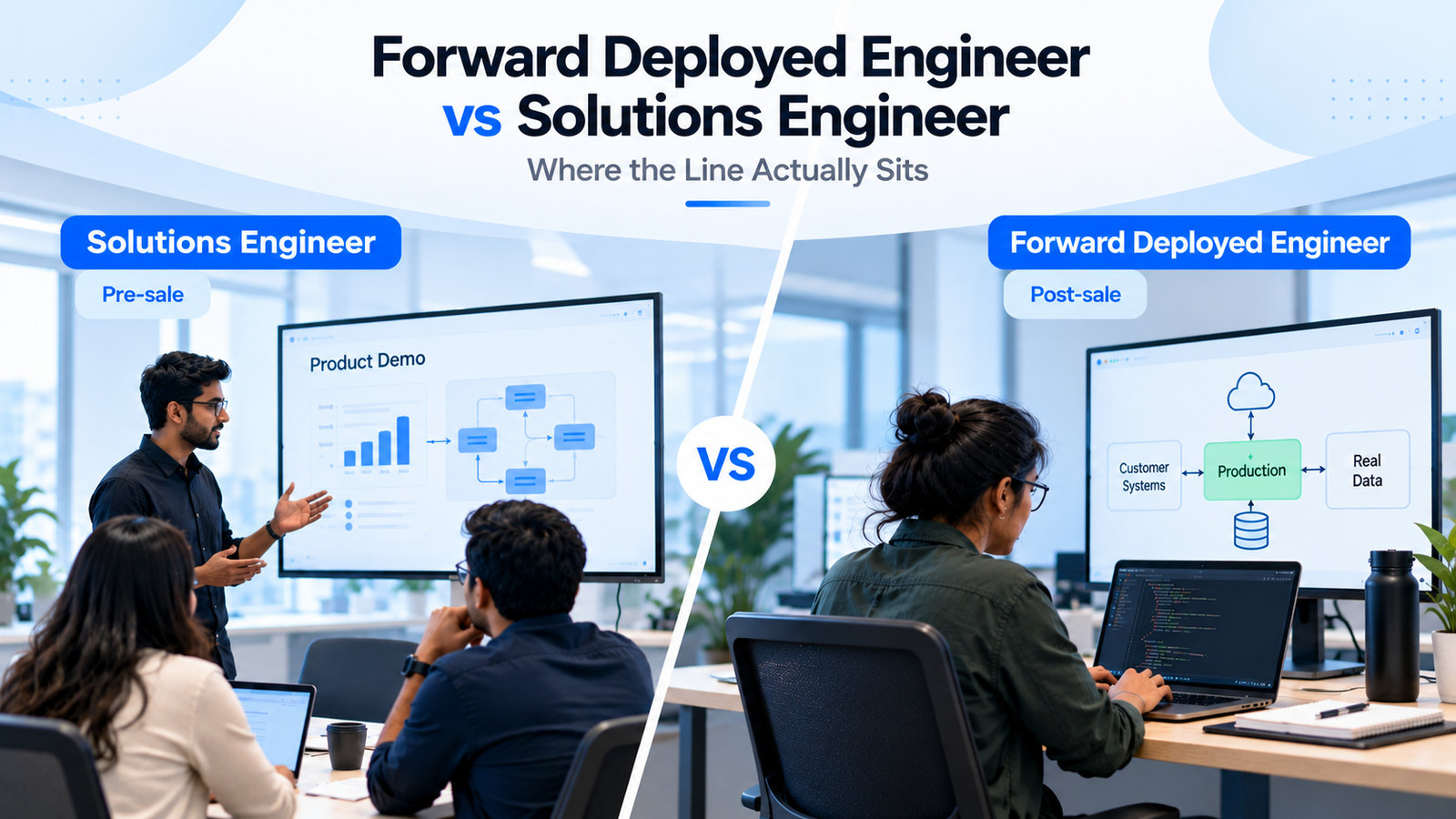
The short answer: a solutions engineer mainly helps a customer buy (demos, proofs of concept, technical answers during a sales cycle), while a forward deployed engineer helps a customer succeed after buying by writing and owning production code inside their environment. The titles blur in smaller companies. We cover the full comparison in our guide to forward deployed engineer vs solutions engineer.
Is the FDE model always the right answer?
No. The model has real limits, and a definition is incomplete without them. Writing in April 2026, industry analyst Peter Bendor-Samuel argued that FDEs are most valuable in dynamic, "agentic native" environments where systems change continuously, and that in stable enterprise systems built around controlled release cycles, embedded engineers making fast changes "can bypass these safeguards". His summary: "The question is not whether they are good or bad; the question is where they fit."
FDE work is also hard to scale linearly and can leave customers dependent on one person's knowledge if handover is weak. For a decision framework, see our guide on when to hire a forward deployed engineer; for budgets, see what forward deployed engineering costs.
In-house FDE vs an FDE delivered by a partner
Organizations get FDE capacity in three ways. In the vendor model, your software or model provider sends its own FDEs, as Palantir, OpenAI, and Anthropic do for strategic customers. The other two are choices you control.
| In-house FDE | FDE delivered by a partner | |
|---|---|---|
| Who employs the engineer | You | An engineering firm under contract |
| Vendor neutrality | Yes | Depends on the partner; ask |
| Time to first engineer on the problem | Depends on your hiring pipeline for a scarce, senior profile | Depends on the partner's bench |
| Knowledge retention | Stays with your staff | Must be planned through documentation and handover |
| Best suited to | A long-running AI program with a stable roadmap | A defined deployment, a spike in demand, or proving value before hiring |
| Main risk | Slow or failed hiring for a rare skill set | Dependency on the partner without a handover plan |
Vendor FDEs know their own product deeply but have little reason to suggest a different model or tool. Partner-delivered FDEs bring the embedded, ship-to-production pattern without a long hiring cycle, provided the contract covers code ownership and handover.
How fwdpod approaches forward deployed engineering
Fwdpod builds dedicated AI engineering pods for startups and enterprises, covering LLM development, RAG systems, AI agents, and product delivery. Its forward deployed engineering service places engineers inside a buyer's AI program for organizations in the US, UK, EU, and Gulf, with engineering delivery from India.
If you are weighing a partner-delivered FDE against hiring, you can configure your AI engineering pod and see how the team would be staffed.
Key takeaways
- An FDE is a customer-embedded software engineer who owns taking a product or model to production for one organization.
- The role began at Palantir as the "Delta," paired with Deployment Strategists ("Echos").
- AI companies adopted it from 2025; in 2026 OpenAI launched a Deployment Company built around FDEs.
- A forward deployed AI engineer applies the same pattern to LLM applications and agents.
Frequently Asked Questions
What does FDE stand for in tech?
FDE stands for forward deployed engineer. Palantir uses the longer title Forward Deployed Software Engineer (FDSE), and some companies use FDE and FDSE interchangeably.
Why is it called "forward deployed"?
The phrase comes from military usage, where forward deployed units are stationed close to the front line rather than at headquarters. In software, the engineer is placed close to the customer's operations, data, and users rather than inside the product team.
Do forward deployed engineers write code?
Yes. Writing, testing, and shipping production code is the core of the job, which is what separates an FDE from a consultant or an account manager. Current OpenAI and Anthropic postings both require production-grade programming skills, mainly in Python.
Is a forward deployed engineer the same as a consultant?
No. A consultant usually advises and may hand over a design, while an FDE builds and ships the working system inside the customer's environment. FDEs employed by a product company also feed field lessons back into that product, which a typical consultant does not.
Is forward deployed engineer a good career path?
It suits engineers who like ambiguity, customer contact, and seeing their code used immediately. The role builds a rare mix of engineering and business judgment, but it often involves travel and less time on deep, long-term platform work.
Can a forward deployed engineer work remotely?
Partly. Most FDE roles expect regular time at customer sites; for example, OpenAI lists up to 50% travel and Anthropic estimates 25% for their FDE roles. Remote work is common between visits, especially for integration and hardening.
What is the difference between a Delta and an Echo at Palantir?
At Palantir, a Delta is a Forward Deployed Software Engineer focused on the technical deployment, while an Echo is a Deployment Strategist whose work is closer to product management. They usually work on the same customer project, and in practice their responsibilities overlap.