When to Hire a Forward Deployed Engineer (and When You Genuinely Do Not Need One)
When to hire a forward deployed engineer: seven signals you need one, five signs you do not, and which alternative fits each situation before you commit budget.
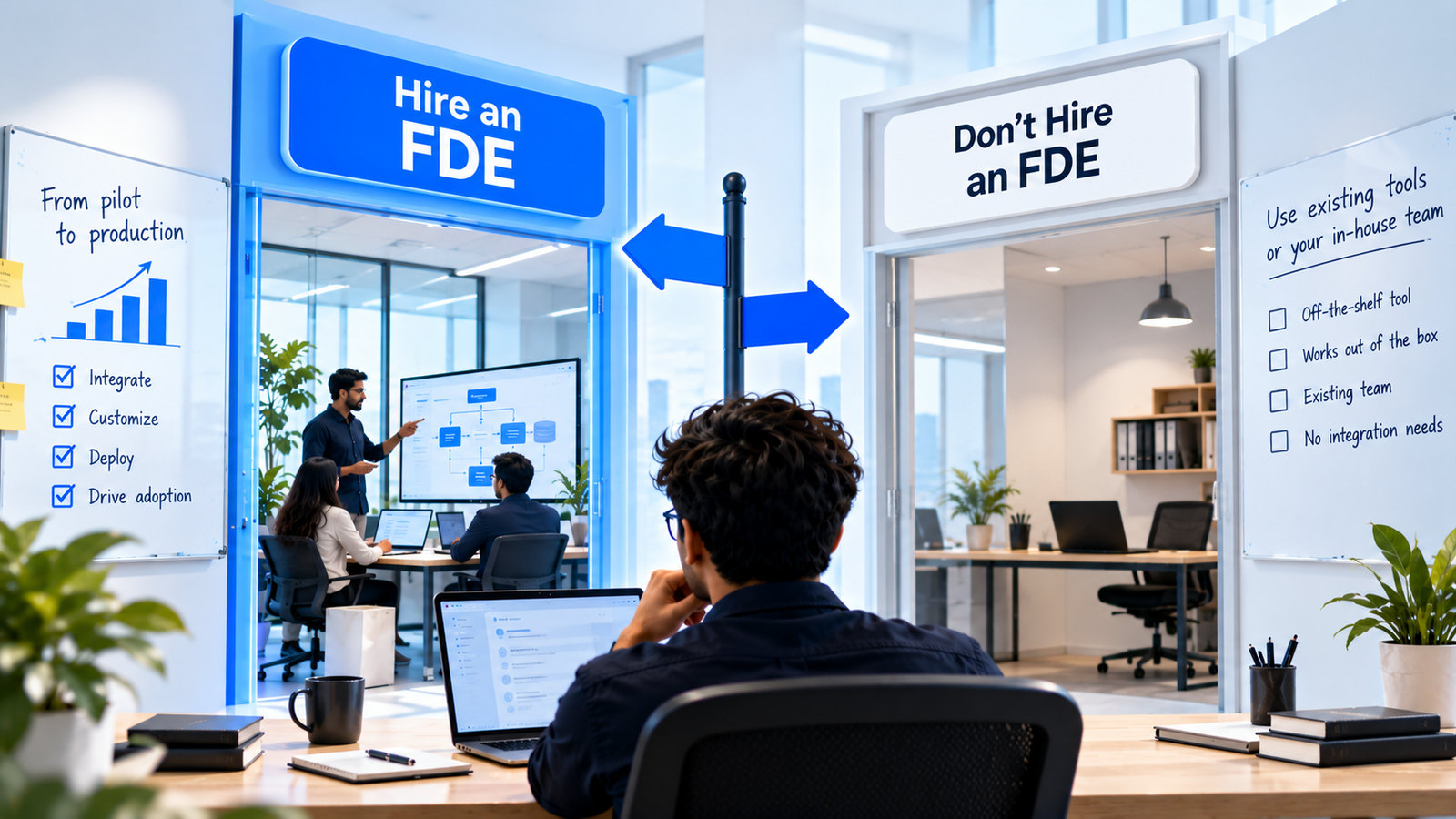
Hire a forward deployed engineer when an AI system has to work inside your specific data, tools and workflows, nobody on your team owns getting it there, and the requirements will only become clear once someone is building. If the tool works out of the box, or your team already ships AI to production, you probably do not need one.
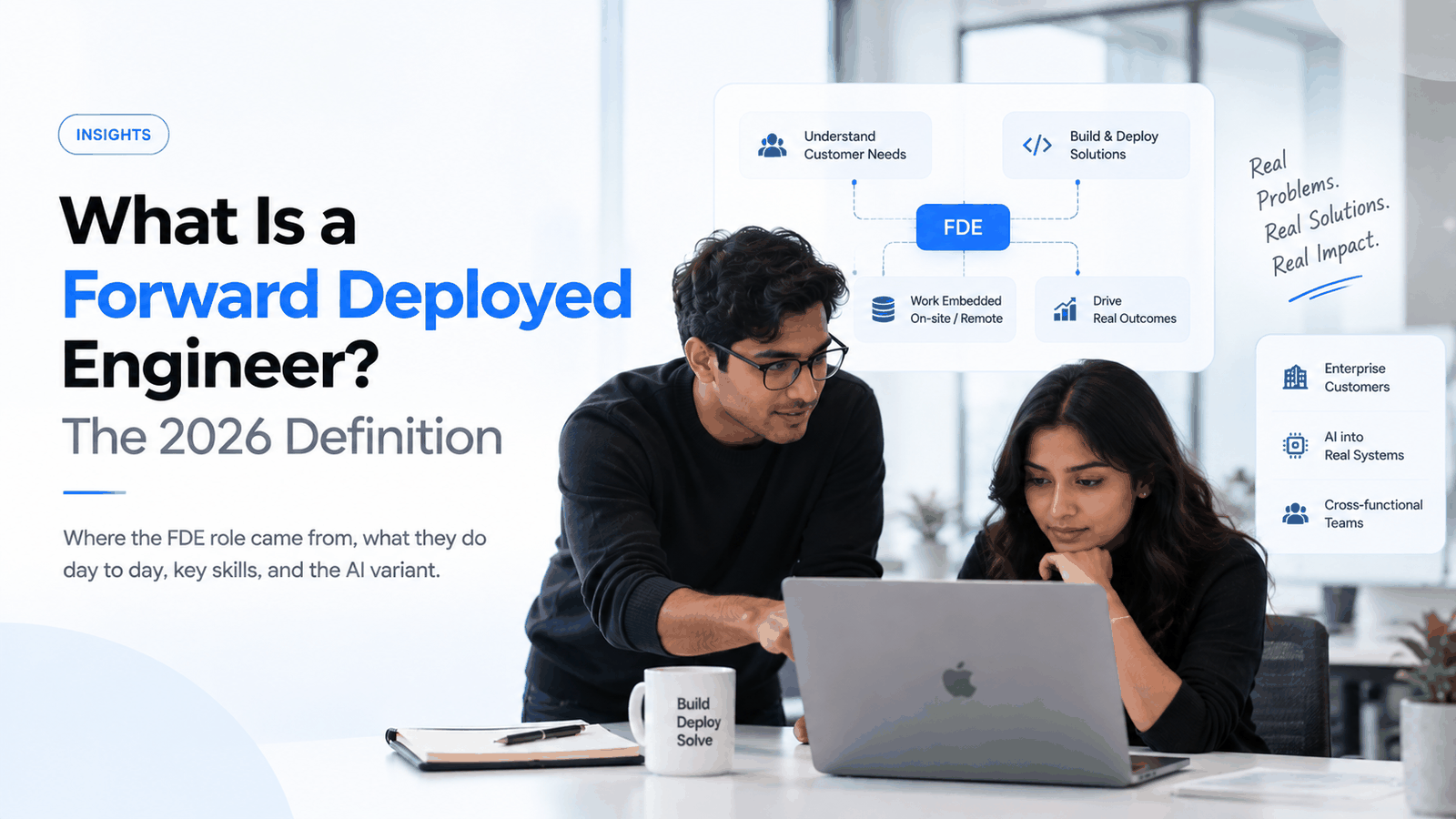
That is the short answer to when to hire a forward deployed engineer. The rest of this guide turns it into a decision you can defend: the signals that point to an FDE, the signals that point away, and what to do instead when the answer is no. If you need the role explained first, start with our guide on what is a forward deployed engineer, or browse all our Forward Deployed Engineering guides.
What gap is an FDE hired to close?
A forward deployed engineer closes the gap between "the AI works in a demo" and "the AI works in our business." Palantir, widely credited with creating the role, sums up the job as "one customer, many capabilities": one engineer owning whatever it takes to make the software solve one customer's problem.
That gap is where most AI projects stall. Gartner predicted in July 2024 that at least 30% of generative AI projects would be abandoned after proof of concept by the end of 2025, citing poor data quality, inadequate risk controls, escalating costs and unclear business value. MIT NANDA's 2025 report The GenAI Divide found that purchasing from specialized vendors and building partnerships succeeded about 67% of the time, while internal builds succeeded about one-third as often. Its lead researcher blamed integration with real workflows, not model quality.
So the real question is not "do we want an FDE?" It is "is integration into our workflow the thing standing between us and production?"
Seven signals you need a forward deployed engineer
Each signal below is a situation, not a feeling. Two or more usually justify the conversation.
- Your pilot works, but nobody can get it into production. The prototype answers questions in a sandbox. Wiring it to identity, permissions, systems of record and your release process has no owner. This is the classic FDE brief.
- The requirements live in people's heads. The workflow you want to automate is undocumented, varies by team, and only surfaces when someone sits with the operators. An FDE writes code and does the discovery; a contractor working from a spec cannot.
- The data is messy, scattered or permission-sensitive. Andreessen Horowitz's analysis of the FDE trend describes the core work as "securely connecting the AI application to internal databases, APIs, and workflows" so that models have "the context they need." If that sentence describes your hardest problem, it describes an FDE's job.
- You bought an AI platform and adoption is flat. Licenses are live, usage is low, and the vendor's customer success team offers training rather than code. Someone needs to build the specific integrations and agents your teams would actually use.
- The system will keep changing after launch. Agents, prompts, tools and evaluation sets need adjusting as the business changes. Peter Bendor-Samuel has argued that FDEs are most valuable in dynamic, agent-driven environments where "you cannot rely on slow, controlled release cycles."
- The stakes justify senior attention. The use case touches revenue, a regulated process or a board-level commitment, and a failed pilot would cost more than a senior engineer's time.
- You need to prove value before you build a team. You are not sure yet whether AI earns a permanent headcount line. An embedded engineer can take one use case to production and show you what the permanent team should look like.
Five signs you do not need one
Saying no is a valid outcome. These are the situations where an FDE is the wrong spend.
- An off-the-shelf tool already does the job. If a SaaS copilot or a vendor's standard integration covers the use case with configuration, buy it and invest in adoption. Custom engineering adds maintenance you do not need.
- You do not have a problem yet, only an interest in AI. An FDE needs a named workflow and a metric to move. Without them, you are paying a senior engineer to run a strategy workshop. Start with a readiness assessment or a use-case sprint.
- Your environment is stable and tightly governed. Bendor-Samuel's warning applies here: in systems built around controlled release cycles, embedded engineers making fast changes "can bypass these safeguards," creating security and failure risk. Your existing delivery process may simply need AI skills added to it.
- Your team already ships AI to production. If you have engineers who have taken LLM systems through evaluation, security review and on-call, you need capacity, not embedding. Hire more of them, or augment.
- The work is well specified and sits outside core workflows. A defined build with clear acceptance criteria (a document classifier, a batch summarization job) does not need someone embedded in your operations. A delivery team working to a spec will do.
What should you do instead? Matching the situation to the model
When an FDE is not the right call, one of these usually is. The table maps common situations to the model that fits best.
| Your situation | Better fit | Why |
|---|---|---|
| The use case is standard and a product covers it | Buy the SaaS tool; fund adoption and training | No custom code to maintain |
| You have ideas but no prioritized use case | AI readiness assessment or discovery sprint | Produces the brief an FDE would need anyway |
| Your model or platform vendor offers embedded engineers | Use the vendor's FDEs for that product | Deep product knowledge, though not vendor-neutral |
| You have a working team that lacks one skill | Staff augmentation | Adds a specialist under your own management |
| You have a defined, multi-month build and want one accountable team | An AI engineering pod | A managed team owns delivery end to end |
| AI is a permanent, core capability | Hire in-house AI engineers | Knowledge and ownership stay with you |
| You need architectural judgment, not hands on keyboards | Fractional AI CTO or solution architect | Senior direction without a full-time build role |
These options are not exclusive. A common sequence is an FDE to reach first production, then an in-house hire or a pod to run and extend it. Our guide to AI development engagement models sets out who carries the risk in each of these arrangements and the contract clauses that matter.
Is your AI system dynamic or stable?
This one question settles many borderline cases. Look at how often the system you are building will need to change once it is live.
- Changes weekly or faster: new tools added to an agent, prompts tuned against fresh failure cases, evaluation sets growing from production traffic. An embedded engineer who understands both the code and the business keeps it aligned. Lean toward an FDE.
- Changes quarterly or slower: a model sits behind a stable API inside an established application, and releases go through change management. Standard delivery with AI expertise added fits better, and your governance stays intact.
The broader data points the same way. McKinsey's State of AI in 2026 survey, published in August 2026, found that nearly three-quarters of AI high performers report "fundamentally redesigning workflows" because of AI, while only about two in ten respondents report scaling AI agents across their organization. Workflow redesign is exactly the work an FDE is embedded to do. If you are not redesigning a workflow, you may not need one.
What must be in place before an FDE starts?
An FDE hired into an unprepared organization spends the first weeks waiting for access. Check these five items before you sign anything:
- A named business owner who can make decisions about the workflow and will judge whether the result works.
- One problem and one metric. For example, "reduce first-response time on tier-1 support tickets," not "use AI in customer service."
- A path to data and systems access through your identity provider, agreed with security in advance.
- An internal engineer or team who will own the system afterward, involved from week one so handover is continuous rather than a final-week event.
- A realistic view of agent scope. Gartner predicted in June 2025 that over 40% of agentic AI projects will be canceled by the end of 2027 and advised pursuing agentic AI "only where it delivers clear value or ROI." Scope the first deployment narrowly.
If two or more of these are missing, fix them first. The FDE will still be valuable in a month; an FDE without access is not valuable today.
Three timing mistakes buyers make
Hiring too early. The FDE arrives before there is a problem worth solving, and the engagement drifts into exploration with no production target.
Hiring too late. The team spends two quarters on an internal pilot, it stalls on integration, and the FDE arrives to inherit a codebase built for a demo. Sometimes that is recoverable; sometimes restarting is faster, and the first job is deciding which.
Using an FDE to avoid a product decision. An embedded engineer can build anything the business asks for, which makes it tempting to skip deciding what matters. The Andreessen Horowitz analysis notes that heavy customization carries a real cost, "lower gross margins and higher burn rates" for the vendors doing it. For buyers, the equivalent cost is bespoke software that someone has to maintain. Decide what you want before you ask someone to build it.
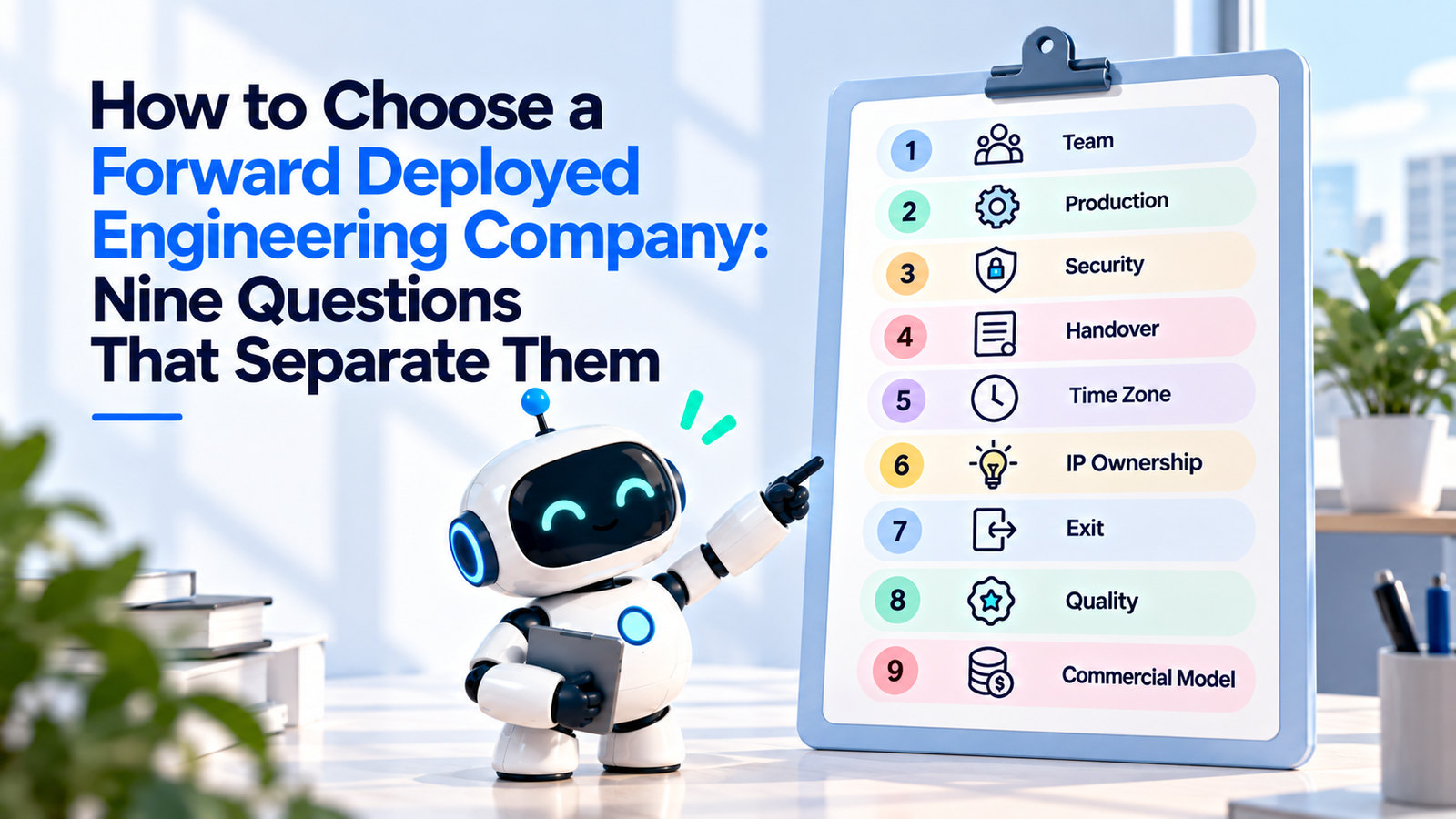
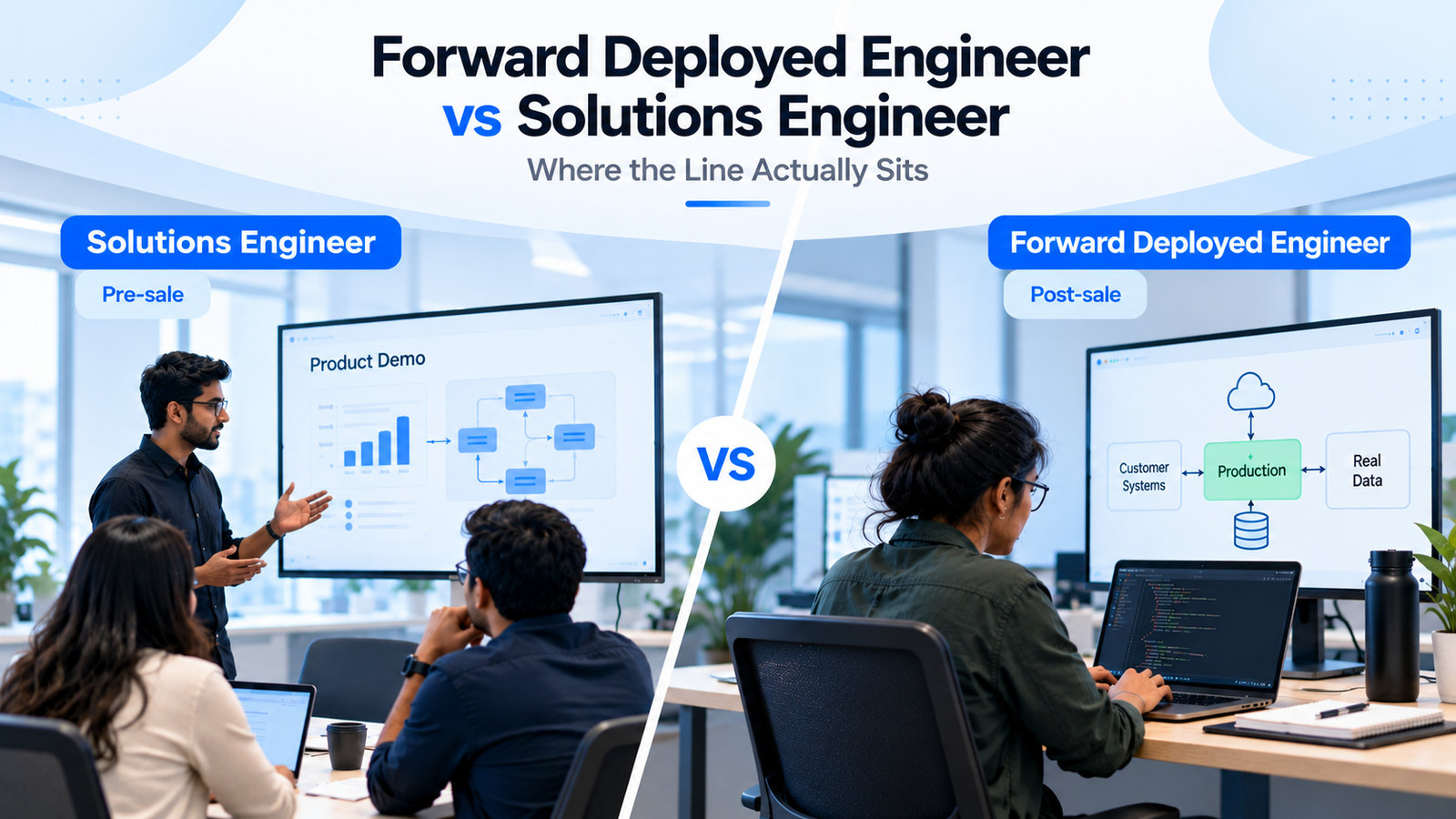
Once you have decided an FDE is right, the next step is checking that the person a vendor offers will actually build. Our comparison of forward deployed engineer vs solutions engineer gives the questions that separate the two, and our guide to who owns the IP when you outsource AI development covers what the contract must say about the code they leave behind. To compare vendors side by side, our guide to choosing a forward deployed engineering company gives nine questions and a scorecard.
How fwdpod approaches this
Fwdpod builds dedicated AI engineering pods for startups and enterprises, covering LLM development, RAG systems, AI agents and product delivery, with engineering delivery from India for buyers in the US, UK, EU and Gulf. We would rather tell a buyer they need a readiness assessment or an off-the-shelf tool than place an engineer with no clear problem to solve. Our AI consulting work includes readiness assessments for exactly that case.
To scope your case, configure your AI engineering pod; for pricing and how engagements are structured, talk to the team.
Frequently Asked Questions
Should a startup hire a forward deployed engineer or a founding AI engineer?
If AI is the product itself, hire a founding AI engineer, because that knowledge must stay in the company. A forward deployed engineer suits a startup that needs AI inside its operations or one customer deployment, or that wants to prove a use case before committing to a permanent hire.
Is one forward deployed engineer enough for an enterprise AI project?
One FDE is often enough for a single, narrowly scoped use case with a strong internal owner. Larger programs with several workflows, heavy data engineering or strict security review usually need a small team around the embedded engineer, such as a pod with data and platform skills.
How long should a forward deployed engineering engagement last?
Tie the end date to handover criteria rather than a calendar. The engagement should run until the system is in production, your team can change and operate it without help, and evaluation and monitoring are in place. Agree those criteria at the start.
Do we still need our own FDE if our AI vendor provides forward deployed engineers?
Not always. A vendor's FDEs are a strong choice for deploying that vendor's product. You may still want an independent engineer if the work spans several vendors, involves your own systems more than theirs, or you want advice that is not tied to one provider.
Is it too late to bring in a forward deployed engineer after a pilot has failed?
No, but the first job changes. The engineer should start by assessing whether the existing prototype, data pipelines and evaluation are worth keeping or whether a narrower restart is faster. Expect that assessment before any commitment to a production date.
Do we need a forward deployed engineer to roll out an AI copilot like Microsoft 365 Copilot?
Usually not for the rollout itself, which is mainly licensing, permissions hygiene and user training. An FDE becomes relevant when you want to connect the copilot or an agent to internal systems through custom connectors, build workflows on top of it, or measure its impact on a specific process.
Who on our side needs to be available when an FDE starts?
At minimum, a business owner who can make workflow decisions, someone from security or IT who can grant access, and the engineer or team who will own the system later. Without these three people, an FDE loses early weeks waiting for decisions and access.