What Is an AI Pod? How a Small Cross-Functional Team Ships AI Faster Than a Hire-and-Build Team
What is an AI pod? A small, cross-functional team that owns one AI outcome end to end. Learn where pods come from, how they differ, and when they fit badly.
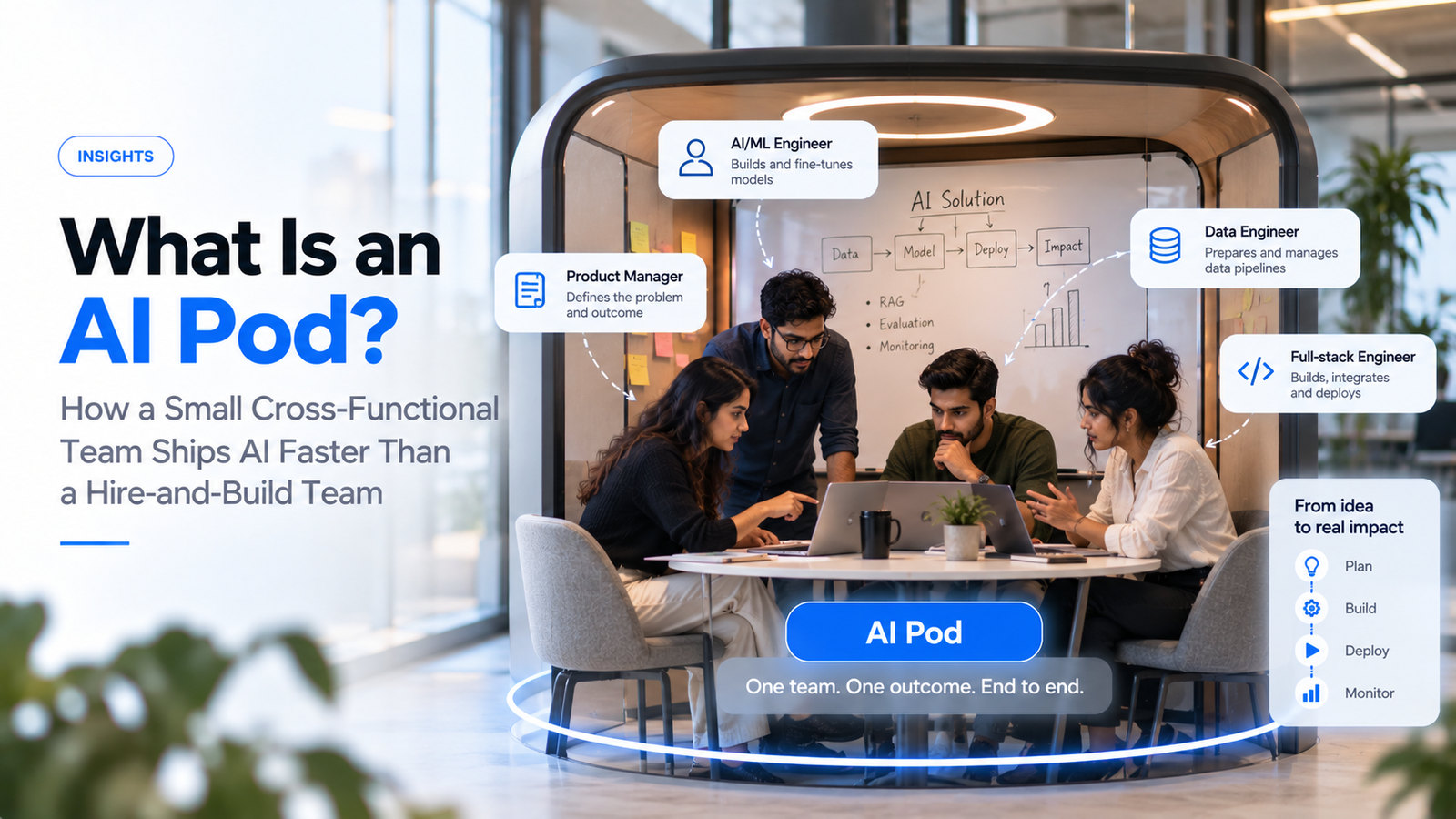
An AI pod is a small, cross-functional engineering team that owns one AI outcome end to end: scoping, data, model and prompt work, evaluation, deployment and monitoring. It arrives already formed, works as a single unit against a defined goal, and is usually engaged from an outside partner so a company can ship AI without first hiring every role itself.
Below: where the idea comes from, what makes an AI engineering pod different from an ordinary development team, how pods are engaged, and when a pod is the wrong choice. It is part of our AI pods and engineering teams series.
What does "AI pod" actually mean?
"Pod" has no single official definition, and vendors use it loosely. Most uses share four traits:
- Small. A pod is a handful of people, not a department. It is sized so that everyone can hold the whole problem in their head.
- Cross-functional. The pod contains every skill needed to get from idea to running software, so work does not queue up waiting for another team.
- Outcome-owned. The pod is pointed at a result ("deflect a share of tier-one support tickets", "answer policy questions from the internal knowledge base") rather than a list of tasks.
- Persistent for the engagement. The same people stay on the problem, so knowledge about the data, the users and the failure modes accumulates in one place.
An AI pod adds a fifth trait: the pod is built around the specific work that makes AI systems hard to ship. That means evaluation, data handling and the operational discipline of running models in production, which we cover below.
A useful way to separate the terms:
- AI pod or AI engineering pod: the team shape and way of working.
- Dedicated AI engineering team: a pod (or larger group) assigned to one client or product full time, as opposed to shared across several.
- Staff augmentation: individual engineers added to your existing team, who follow your process and your management.
Where did the pod model come from?
AI pods borrow from two well-documented ideas in software team design.
Amazon's two-pizza teams
Amazon popularized the rule that no team should be bigger than two pizzas can feed. AWS describes the two-pizza team as a group kept small, ideally fewer than ten people, so that lines of communication stay short. Each team has a single-threaded focus on one product or service and is accountable for it end to end, from ideation through operations. AWS also frames the benefit in terms of learning speed: faster experimentation lowers the cost of failure because lessons arrive sooner and at lower stakes.
That matters more for AI than for most software, because an AI feature's quality is only discovered by testing it against real inputs.
Team Topologies and stream-aligned teams
The second influence is Team Topologies by Matthew Skelton and Manuel Pais, published in 2019. The book defines four team types. The most relevant here is the stream-aligned team: a team aligned to a flow of work from a segment of the business, which delivers value directly and owns outcomes end to end with no handoffs.
Team Topologies also describes an enabling team, which helps a stream-aligned team overcome obstacles and fill missing capabilities for a period of time, and a collaboration interaction mode, where two teams work closely together for a defined period to discover new things.
An externally engaged AI pod often behaves like a blend of the two. It works like a stream-aligned team on the AI outcome itself, and like an enabling team toward your internal engineers, who will usually own the system after the engagement ends.
What makes an AI pod different from a regular dev pod?
A generic product pod and an AI pod look similar on an org chart; the difference is what they must get right. Google's architecture guidance on MLOps puts it plainly: "Only a small fraction of a real-world ML system is composed of the ML code." Google Cloud goes on to note that testing an ML system is more involved than testing other software, that deployment can mean shipping a multi-step pipeline rather than a single service, and that models can decay in more ways than conventional software.
Google engineers' 2015 research paper, Hidden Technical Debt in Machine Learning Systems, argued that the quick wins of machine learning come with "massive ongoing maintenance costs" driven by entanglement, hidden feedback loops, data dependencies and configuration issues. LLM applications inherit most of those risks and add their own, such as non-deterministic outputs.
Those differences shape what the pod spends its time on:
| Concern | Typical product dev pod | AI pod |
|---|---|---|
| Definition of "done" | Feature works as specified; tests pass | Output quality meets an agreed bar on a representative eval set |
| Testing | Unit, integration and end-to-end tests with fixed expected results | All of those, plus evals that grade variable outputs, data validation and regression checks on model or prompt changes |
| Main dependency | Application code and APIs | Data quality, retrieval sources, model behavior and third-party model versions |
| Release risk | Bugs in new code | Silent quality regressions when data, prompts or the underlying model change |
| Production work | Uptime, errors, latency | Uptime and latency, plus quality monitoring, cost per request, drift and feedback capture |
| Key skills | Frontend, backend, QA, DevOps | Backend and product engineering, plus LLM/ML engineering, data engineering, evaluation and MLOps/LLMOps |
Evals are the center of gravity
The single biggest behavioral difference is that an AI pod treats evaluation as a first-class engineering artifact. Anthropic's engineering team defines an eval as "a test for an AI system: give an AI an input, then apply grading logic to its output to measure success." The same January 2026 guide warns that without evals teams "get stuck in reactive loops," catching issues only in production, where fixing one failure creates others. It also suggests 20 to 50 simple tasks drawn from real failures as a starting point, well within reach of a small team.
In practice, a well-run AI pod builds its first eval set in the first days of an engagement, before much feature code exists, and every later change is measured against it.
Data is part of the job, not an input to it
A generic dev pod usually consumes data through a stable API. An AI pod often has to find, clean, chunk, label or permission its data before the system can work, and it has to keep doing so as sources change. For a retrieval-augmented generation (RAG) system, retrieval quality is often the main determinant of answer quality, so data engineering sits inside the pod rather than in a ticket queue elsewhere.
Operations never really end
Because models, prompts and source data all change, an AI system needs ongoing monitoring of quality and cost, not just uptime. That is why most AI pods include MLOps or LLMOps capability from the start rather than bolting it on before launch.
Who is in an AI pod?
Composition varies with the problem, so treat this as a summary, not a template. Most AI pods combine some version of these capabilities:
- Technical lead or AI architect, who owns design decisions and trade-offs
- LLM or ML engineers, who build prompts, retrieval, agents or models
- Backend or full-stack engineer, who integrates the AI into the real product
- Data engineer, who owns pipelines, source data and access controls
- Evaluation and QA, often shared across the engineers rather than a separate person
- MLOps / LLMOps, covering deployment, monitoring and cost control
- Delivery or product lead, who keeps the pod pointed at the business outcome
On size, the industry pattern follows the two-pizza logic: small enough that communication overhead stays low, which in practice usually means a single-digit headcount. A narrow proof of concept may need only two or three people; a multi-system agent rollout may need more, sometimes split into two pods. You can see how the roles are grouped in practice in the pod catalogue.
Why can a pod ship faster than a hire-and-build team?
"Hire-and-build" means recruiting each role individually, then forming them into a team, then starting the work. A pod reverses the order: the team already exists, so the work can start first. The speed difference comes from a few mechanical sources rather than from anyone working harder.
Hiring is sequential; a pod is not. Building an AI team in-house means sourcing, interviewing and onboarding several specialist roles, often one after another, and the project cannot really start until the key ones are in seat. A pod skips that queue. How much time this saves depends on your market and hiring process, so be wary of anyone who quotes a universal number.
The team has already formed. New teams spend early weeks agreeing how to work: review norms, how to run evals, who decides what. An established pod brings those norms with it.
Handoffs disappear. When data, model, backend and ops skills sit in one team, a retrieval problem found on Tuesday can be fixed on Tuesday. In a functional structure, the same problem becomes a ticket for the data team.
Patterns transfer. A pod that has shipped several RAG systems or agent workflows has already made, and fixed, the common mistakes.
Short feedback loops. Small teams can run more eval-driven experiments per week, which, as the two-pizza rationale suggests, lowers the cost of each wrong turn.
None of this makes a pod automatically faster. A pod pointed at a vague goal, blocked from data access, or waiting on security review will move no faster than an in-house team facing the same blockers.
How is an AI pod engaged?
Engagement details vary by provider, but most follow a recognizable arc:
| Phase | What happens | What you should see |
|---|---|---|
| Scoping | Agree the business outcome, users, constraints and data sources | A written problem statement and success criteria |
| Access and setup | Environments, data access, security review, repo and tooling | Pod can run code against real (or approved sample) data |
| Baseline and evals | First eval set built from real examples; simplest working version measured | A baseline score you can compare every later change against |
| Iterative build | Short cycles of change, evaluate, ship to a controlled group | Eval scores and user feedback trending the right way |
| Production hardening | Monitoring, guardrails, cost controls, runbooks | A system your ops team can support |
| Handover or continuation | Documentation, knowledge transfer, or a scoped next phase | Your team can own it, or a clear plan for who does |
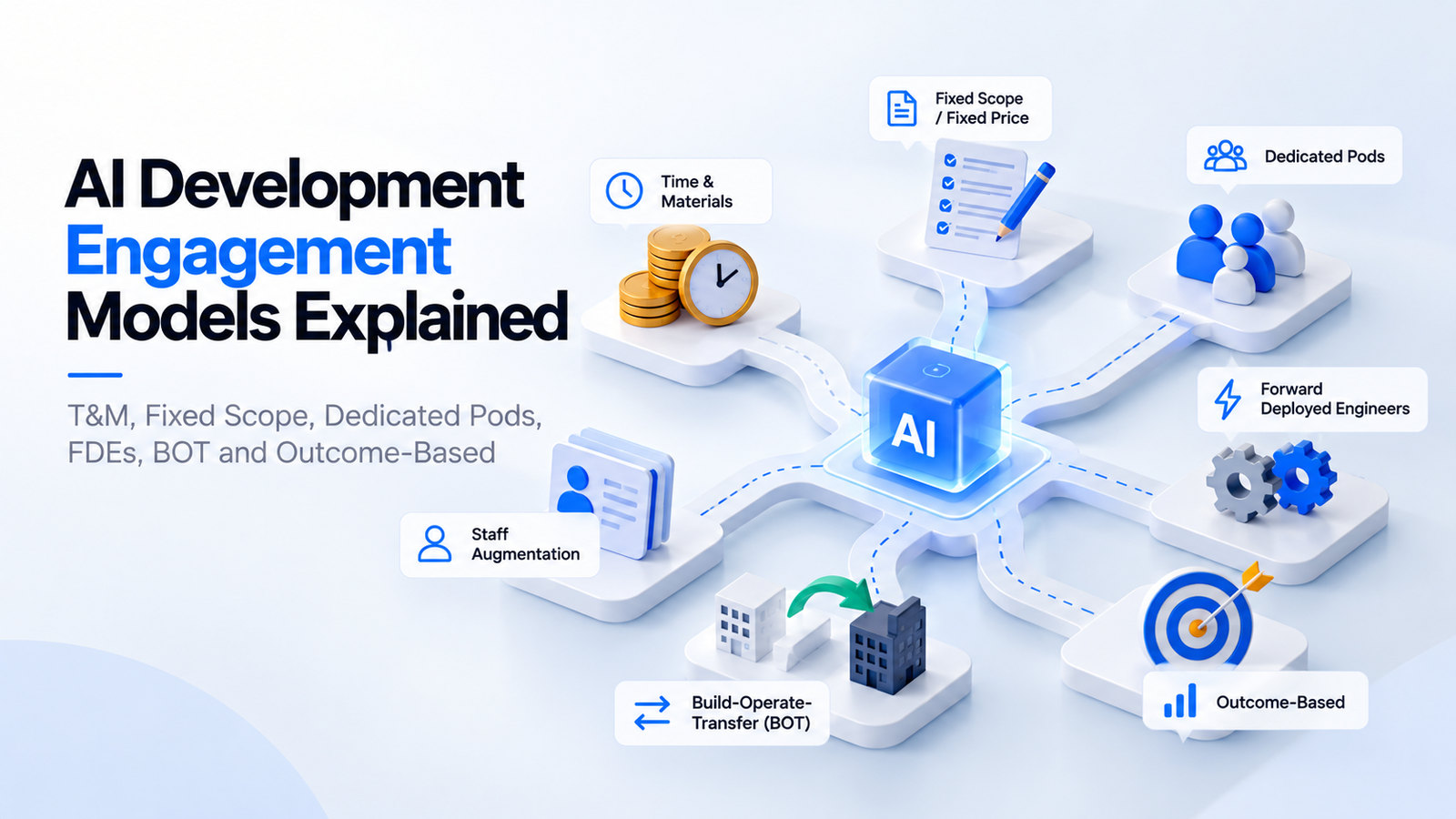
Commercially, pods are usually offered as a dedicated pod (the team works only on your product) or a shared pod (capacity split across clients), and priced on a time-and-materials, monthly retainer or fixed-scope basis. For pricing and start dates, talk to the team.
Whatever the model, ask any provider three things up front: who owns the code and data produced, which named people will be on the pod, and what happens to knowledge when the engagement ends.
Is an AI pod the same as staff augmentation?
No. With staff augmentation you rent individual engineers who slot into your team and follow your management and process; you own delivery. With an AI pod you engage a whole team that brings its own way of working and shares accountability for an outcome. Augmentation suits companies that already have a strong AI lead and a gap in hands, and is offered as its own service through team augmentation. A pod suits companies that lack the AI-specific practices, not just the headcount.
When is an AI pod a bad fit?
A pod is a tool for a specific kind of problem. It is a poor choice when:
- The goal is undefined. If you cannot yet say what the AI should do or how you would judge it, start with a short discovery or readiness exercise, not a full pod.
- The work is tiny. A single prompt tweak or one small integration does not need a cross-functional team. One engineer, or a vendor's off-the-shelf feature, may be enough.
- AI is your core, long-term differentiator. If the model or the AI product is the company, you will eventually need the capability in-house. A pod can still help you start and hand over, but plan for the handover from day one.
- You cannot grant data access. A pod blocked from real data will spend its time on synthetic demos. Solve legal, security and access questions first.
- Nobody internal will own the result. Every AI system needs an internal owner after launch. Without one, the pod's work decays when the engagement ends.
- A proven product already solves it. If a mature SaaS tool meets the need, buying it is usually cheaper than building anything.
How do I add AI to my product without hiring?
Often this is the real question behind "what is an AI pod." In short: engage a small team that already has the AI-specific skills, point it at one measurable outcome, and make sure one of your own engineers works alongside it so the knowledge stays with you. Buying a product feature or bringing in a single specialist are the other two routes, and they suit narrower problems.
How fwdpod approaches AI pods
Fwdpod builds dedicated AI engineering pods for startups and enterprises, covering LLM development, RAG systems, AI agents and product delivery, with engineering delivery from India for buyers in the US, UK, EU and the Gulf. Pods are designed around the practices described above: evaluation from the start, data and integration work inside the team, and a production handover your engineers can own.
If you are weighing whether a pod fits your roadmap, the pod catalogue shows the pre-assembled pods and what each one covers, or you can configure your AI engineering pod and get a proposal for your own use case.
Key takeaways
- An AI pod is a small, cross-functional, outcome-owned team that takes an AI system from idea to production.
- The model draws on Amazon's two-pizza teams and Team Topologies' stream-aligned teams.
- What separates an AI pod from a generic dev pod is evaluation, data work and ongoing model operations.
- Pods save time mainly by skipping sequential hiring and team formation, not by working harder.
- A pod fits badly when goals are vague, work is tiny, data is inaccessible or nobody will own the result.
Frequently Asked Questions
How big is a typical AI pod?
Most AI pods are small, following the two-pizza principle of fewer than ten people, and many run with a single-digit headcount. The right size depends on scope: a narrow proof of concept may need two or three people, while a multi-system rollout may need a larger pod or two pods working in parallel.
Is an AI pod only for large enterprises?
No. Startups often use pods because they cannot justify hiring several AI specialists before a feature has proven its value. Enterprises tend to use them to move a specific initiative forward while internal hiring or platform work continues.
Does an AI pod replace my in-house engineering team?
It should not. A pod works best alongside your team, with at least one internal engineer embedded so they understand the system well enough to own it later. Treat the pod as a way to build capability, not to outsource it permanently.
What should an AI pod deliver in its first few weeks?
Expect a written problem statement, working access to data, a first evaluation set built from real examples, and a simple baseline version measured against it. If a pod is only showing demos with no way to measure quality, ask why.
Can an AI pod work with our existing cloud and security setup?
Usually yes, and it should. Most AI pods work inside the client's cloud accounts, repositories and access controls so the code and data stay under your ownership. Confirm this in the contract, along with IP ownership and data-handling terms.
What is the difference between a dedicated and a shared AI pod?
A dedicated pod works only on your product for the length of the engagement. A shared pod splits its capacity across more than one client, which can lower cost but also reduces focus and availability. Dedicated pods suit ongoing product work; shared pods can suit smaller or intermittent needs.
What happens when the AI pod engagement ends?
A good engagement ends with documentation, runbooks, an eval suite your team can run, and knowledge transfer sessions. Some companies then continue with a smaller pod for maintenance; others take full ownership. Agree which outcome you want before the work starts.