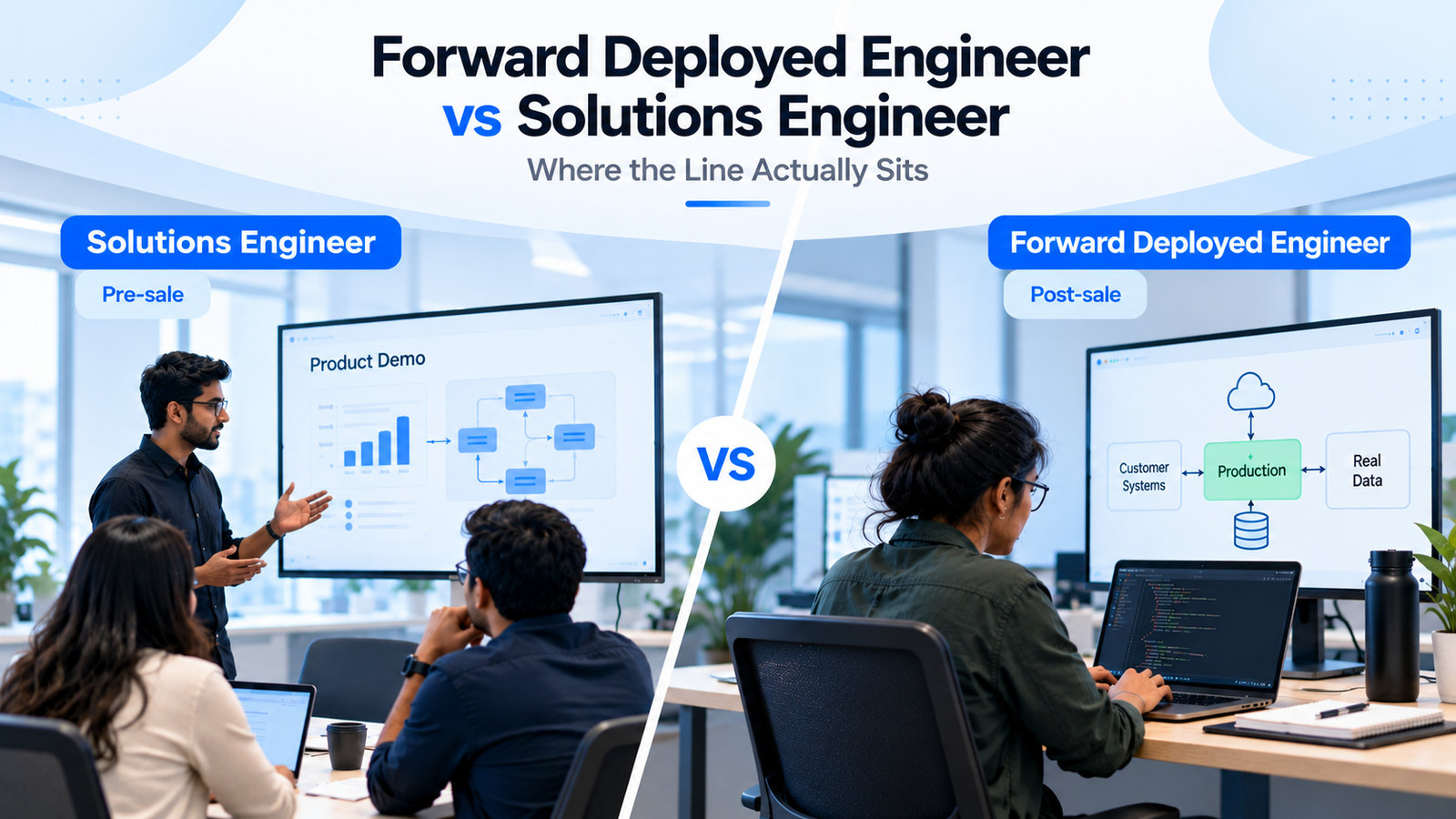
How to Choose a Forward Deployed Engineering Company: Nine Questions That Separate Them
Nine questions to ask any forward deployed engineering company, with good and red-flag answers and a scorecard to compare FDE partners before you sign.
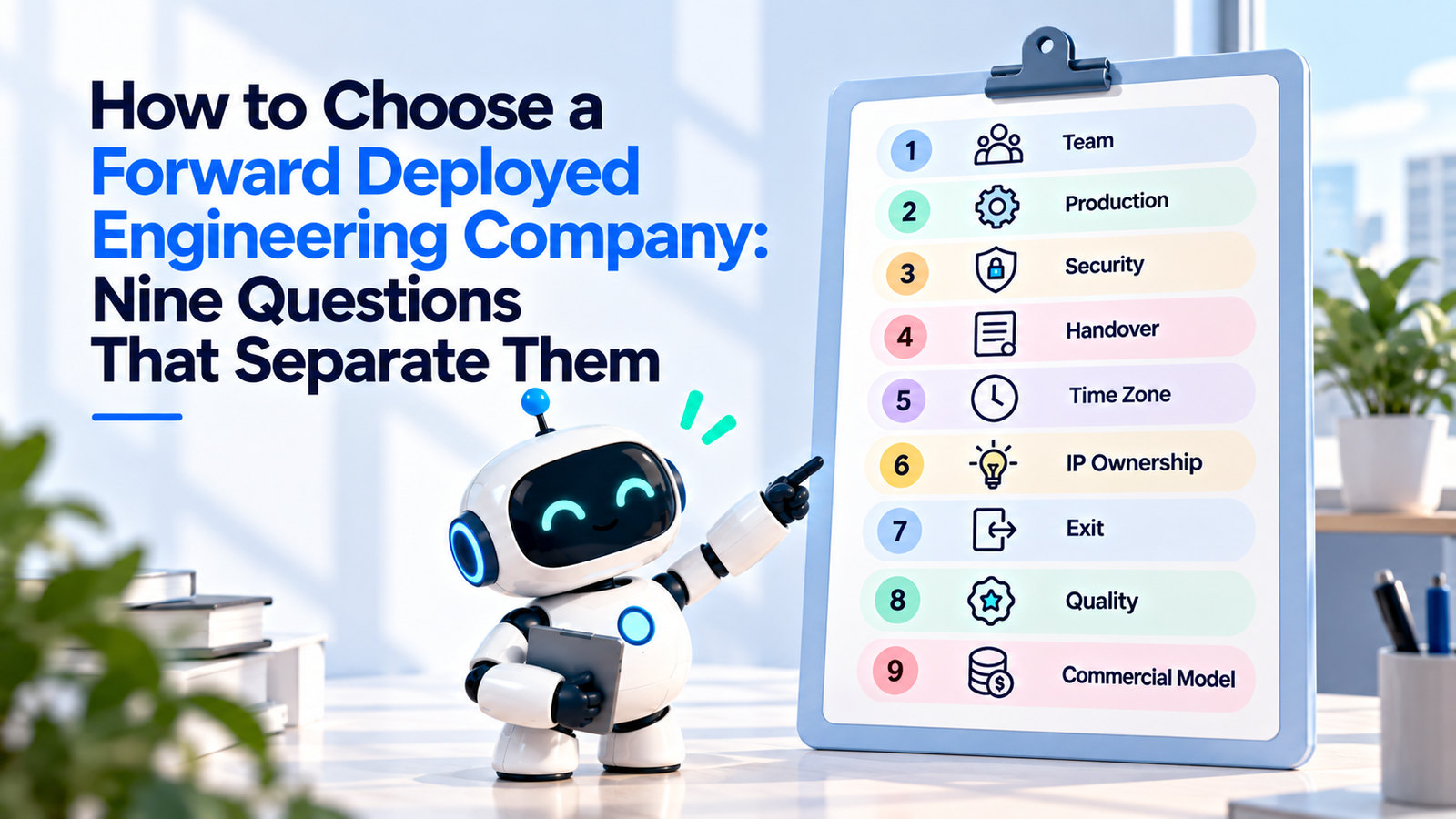
To choose a forward deployed engineering company, test how it embeds, not how it pitches. Ask nine things: who is actually embedded, who owns production, how access to your systems is limited, how handover works, how time zones are covered, who owns the IP, how you exit, how quality is measured, and what the commercial model rewards. Score each answer, then compare.
Generic outsourcing checklists miss what makes this model different: the engineers sit inside your team, touch production, and are expected to leave you more capable. If you are still deciding whether you need an embedded engineer at all, start with our guide on when to hire a forward deployed engineer. For more on the model itself, browse our Forward Deployed Engineering guides.
What makes a forward deployed engineering company different from a dev shop?
Palantir, which popularized the model, described its forward deployed software engineer in 2020 as someone who "embeds directly with our customers" and focuses on "enabling many capabilities for a single customer," in contrast to a product engineer who builds one capability for many customers. Andreessen Horowitz argued in June 2025 that AI vendors are adopting the same pattern because enterprises need hands-on help getting AI into production, and noted that 22 of OpenAI's 311 open roles at the time sat in forward deployed and solutions engineering categories.
A forward deployed engineering partner sells that embedded capability as a service, usually without a platform attached. You are buying judgment exercised inside your organization, so the questions focus on proximity, access, ownership and exit rather than tech stack.
Question 1: Who is actually embedded, and who sits behind them?
Why it matters. The value of forward deployed engineering services comes from the specific people in your standups. If the engineers in the sales call are not the ones who show up, the model has already failed.
- Good answer: Named engineers, with CVs and a short technical call before signing. A clear line between the forward deployed AI engineer in your team and any back-office support (reviewers, specialists), plus a written policy on substitutions.
- Red flag: "We'll assign the right resources after kickoff." A pitch team of senior architects who disappear once the contract is signed.
Question 2: Who owns production once it ships?
Why it matters. An FDE vendor that only builds demos is a prototype shop with a nicer name.
- Good answer: A clear split of who is on call, for which services, during which hours, with runbooks and incident reviews shared with your team. Support terms written into the contract, not promised in a slide.
- Red flag: "Your ops team will take it from there" with no runbook, no monitoring handoff, and no joint incident process.
Question 3: What access do you need to our systems, and how will you limit it?
Why it matters. Embedded engineers need real access: repositories, data, cloud accounts, sometimes production. AI agents built by those engineers need access too. The OWASP GenAI Security Project lists Excessive Agency (LLM06:2025) as a top risk for LLM applications, tracing it to excessive functionality, excessive permissions and excessive autonomy, and recommends limiting each to "the minimum necessary" with human approval for high-impact actions.
- Good answer: Engineers work through your identity provider and your devices or managed environments, with scoped roles that are reviewed and revoked on exit. Agents get their own least-privilege service identities. Any subcontractors are disclosed up front. If personal data of EU or UK residents is involved, the vendor is ready to sign a processing agreement; GDPR Article 28(2) bars a processor from engaging another processor "without prior specific or general written authorisation."
- Red flag: Shared admin credentials, copies of your data on the vendor's laptops, or vague answers about who else touches the work.
The full control list is a topic of its own; see our guide to data security in offshore AI development.
Question 4: How does knowledge transfer happen, and how will we know it worked?
Why it matters. A forward deployed engagement should leave your team able to run, change and extend what was built. Without planned handover, you have bought a dependency.
- Good answer: Handover criteria agreed at kickoff, for example "an internal engineer can ship a change to the retrieval pipeline and pass the eval suite without help." Pairing with your engineers from the start, architecture decision records, and documentation that lives in your repo rather than the vendor's wiki.
- Red flag: Handover treated as a final-week slide deck, or a vendor that cannot describe what "done" looks like for knowledge transfer.
Question 5: How do you embed across time zones?
Why it matters. Embedding means presence in decisions. The question is not "are you available?" but "which of our meetings will you attend live?"
- Good answer: Specific overlap hours per engineer, a named person who attends your planning and incident calls live, and clear async rules for everything else. Occasional on-site weeks for discovery or launch if your work needs them.
- Red flag: "We're flexible" with no committed hours, or an account manager who covers overlap while the engineers work entirely offset.
Overlap models vary by region, so ask for the committed hours in writing for each engineer rather than for the team as a whole.
Question 6: Who owns the code, prompts, evaluation sets and model artifacts?
Why it matters. In AI work, the IP includes prompts, retrieval configurations, evaluation data, fine-tuned weights and tool definitions, and default ownership rules may not follow the money. In the US, the Copyright Office's Circular 30 explains that work by an independent contractor counts as a "work made for hire" only if it falls within nine listed categories and both parties sign a written agreement saying so. Custom software often does not fit neatly into those categories, which is why contracts usually add an explicit assignment. In India, Section 17 of the Copyright Act, 1957 makes the author the first owner, with the employer as first owner for work made under a contract of service "in the absence of any agreement to the contrary." That covers the vendor and its staff, not you, so your ownership depends on the contract chain.
- Good answer: An assignment of all project deliverables to you, explicitly listing prompts, eval sets and model artifacts, backed by matching assignment terms between the vendor and each engineer. A clear carve-out for any pre-existing vendor tooling, with a perpetual license for what you need to keep running.
- Red flag: "You own the code" with nothing on prompts, data or weights, or reluctance to show the employee-side agreements.
Not legal advice. This is general information. Involve your counsel.
For more, read who owns the IP when you outsource AI.
Question 7: What happens when we leave?
Why it matters. Exit terms show whether a vendor expects to keep you through value or through friction. Palantir-style FDEs configure the vendor's own platform, which is a different purchase. If you are buying services, you should be able to walk away with a working system.
- Good answer: Everything is built in your cloud accounts and repos from day one. A written exit plan covering credential revocation, documentation, a transition period and data return or deletion. For personal data under GDPR, Article 28(3)(g) already requires the processor to delete or return it at the end of the services unless law requires retention.
- Red flag: Core components hosted in vendor-owned infrastructure, a proprietary "accelerator" you cannot license independently, or long notice periods with no transition support.
Question 8: How do you measure whether the AI is working?
Why it matters. LLM systems fail quietly. A change that improves one answer can degrade fifty others. NIST's AI Risk Management Framework makes "Measure" one of four core functions alongside Govern, Map and Manage, and its Generative AI Profile (NIST AI 600-1) addresses risks specific to generative systems.
- Good answer: A task-specific evaluation suite built early from your real data and edge cases, run automatically on every meaningful change. Production tracing of prompts, tool calls, latency and cost, with dashboards your team can read. Quality targets agreed with the business owner, not just the engineers.
- Red flag: "We test it manually before release," demos in place of metrics, or observability that lives only in the vendor's tools.
Question 9: How are you paid, and what does that reward?
Why it matters. The commercial model shapes behavior. Pure time-and-materials can reward slow handover. Fixed price can reward cutting corners on evals. Outcome-based pricing can reward gaming the metric.
- Good answer: Open about its model's trade-offs, with some milestones tied to handover and production criteria, and freedom to scale down as your people take over.
- Red flag: Minimum terms that outlast the work, rate cards that hide who is actually billing, or no answer to "what does it cost us when this goes well and we need you less?"
Forward deployed engineering company scorecard
Score each vendor 0 (red flag), 1 (partial) or 2 (strong). Weight the rows that matter most to your situation; regulated buyers will usually weight access and IP higher.
| # | Question | Weight (1–3) | Strong answer looks like | Red flag | Vendor A | Vendor B |
|---|---|---|---|---|---|---|
| 1 | Who is embedded | 3 | Named engineers, substitution policy | "Resources assigned after kickoff" | ||
| 2 | Production ownership | 3 | On-call split, shared runbooks | "Your ops team takes it" | ||
| 3 | Access and security | 3 | Your IdP, least privilege, disclosed subcontractors | Shared credentials, data on vendor devices | ||
| 4 | Handover | 2 | Criteria set at kickoff, docs in your repo | Final-week slide deck | ||
| 5 | Time-zone embedding | 2 | Committed overlap hours per engineer | "We're flexible" | ||
| 6 | IP ownership | 3 | Assignment covers prompts, evals, weights | Code only; no employee-side terms | ||
| 7 | Exit | 2 | Built in your accounts, written exit plan | Vendor-hosted core, no transition | ||
| 8 | Evals and observability | 3 | Automated evals, production tracing | Manual testing, demo-driven | ||
| 9 | Commercial model | 2 | Milestones tied to handover, flexible scale-down | Lock-in minimums | ||
| Weighted total (max 46) |
A vendor with a zero on questions 3 or 6 should usually drop off the list regardless of total. Those are the failures you cannot fix mid-engagement.
How to use the nine questions in practice
Send questions 3, 6 and 7 in writing before the first call; the written answers become contract inputs. Ask 1, 2, 5 and 8 live, and ask to speak to an engineer, not just sales. Save 4 and 9 for the proposal stage, when you can compare concrete terms. Our guide to how enterprises buy AI engineering capacity shows where each of those stages sits in a typical procurement path.
How fwdpod approaches this
Fwdpod builds dedicated AI engineering pods for startups and enterprises, covering LLM development, RAG systems, AI agents and product delivery, with engineering delivery from India for buyers in the US, UK, EU and Gulf. We would rather be scored against these nine questions than a slide deck.
Configure your AI engineering pod and score our proposal against the nine questions, or talk to the team about terms and pricing.
Frequently Asked Questions
What is a forward deployed engineering company?
A forward deployed engineering company provides engineers who embed inside a client's team, work in the client's systems and ship production software alongside client staff. Unlike a traditional outsourcing firm that builds to a spec and hands over, the engineers take part in day-to-day decisions and are expected to transfer knowledge before they leave.
How is a forward deployed engineering partner different from an AI consultancy?
An AI consultancy usually advises on strategy, use cases and roadmaps, and may build proofs of concept. A forward deployed engineering partner writes and ships production code inside your environment and shares responsibility for running it. Some firms do both, so ask which team will actually do the build.
Do forward deployed engineers need to work on-site?
Not always. What matters is live presence in the decisions that shape the work: planning, design reviews and incidents. Many engagements combine remote work with committed overlap hours and occasional on-site weeks for discovery or launch.
Can a forward deployed engineering company based in India serve a US or European client?
Yes, if the vendor commits to specific overlap hours, works inside the client's identity and security controls, and has contracts that assign IP and handle personal data correctly under the laws that apply. Test those three points directly rather than relying on general assurances.
What should the contract with a forward deployed engineering vendor include?
At minimum: named engineers and a substitution policy, an IP assignment that covers code, prompts, evaluation data and model artifacts, a data processing agreement where personal data is involved, support and on-call terms, handover criteria and a written exit plan. Have your counsel review the final terms.
Is a paid pilot a good way to evaluate a forward deployed engineering company?
A short paid pilot on a real but contained problem is often the most reliable test. It shows how the engineers work in your systems, how they communicate and whether they build evaluations and documentation without being asked. Agree success criteria and ownership of pilot outputs in writing before it starts.
What is the biggest mistake buyers make when choosing an FDE vendor?
Judging vendors on the pitch team and the demo rather than on the engineers who will be embedded and the terms for handover and exit. Those two factors decide whether you end up with a capable internal team or a long-term dependency.