How to Add AI to Your Product Without Hiring an AI Team
How to add AI to your product without hiring: pick the right first feature, choose managed APIs, a pod, an agency, a freelancer or an FDE, and own the rest.
How to Add AI to Your Product Without Hiring an AI Team
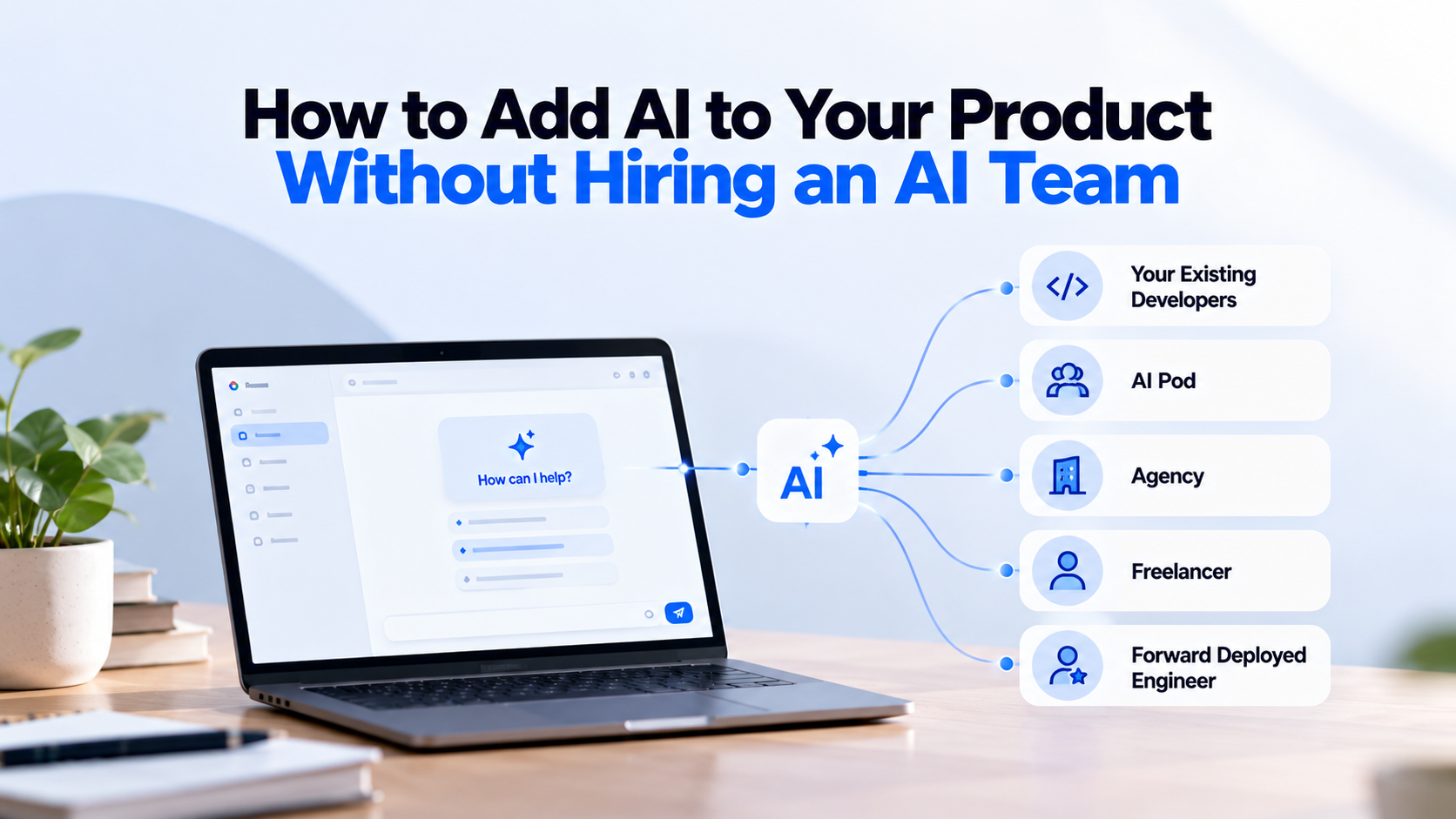
How do I add AI to my product without hiring? Pick one narrow, measurable feature, write down what "good" looks like, then choose who builds it: your existing developers on a managed AI API, an AI pod, an agency, a freelancer or a forward deployed engineer. You can outsource the building. You cannot outsource the product decisions, data access, evaluation or security review.
This guide is written for the product leader who has been told "we need AI in the product" and has no AI engineers and no headcount to hire them. It works through five steps in order, because most failed AI features go wrong in step one, not step three. For more on how teams staff AI work, browse our AI Pods & Engineering Teams guides.
Can you really add AI to a product without hiring?
Yes, and for a first feature it is often the lower-risk path. MIT's NANDA initiative, in The GenAI Divide: State of AI in Business 2025 (150 leader interviews, 350 employee survey responses and 300 public AI deployments), found that buying from specialized vendors and building partnerships succeeded about 67% of the time, while internal builds succeeded about one-third as often (Fortune, Aug 2025). Treat that as one study with its own definitions of "success", not a law.
The bigger risk is not the missing hire. Gartner predicted that at least 30% of generative AI projects would be abandoned after proof of concept by the end of 2025, citing poor data quality, inadequate risk controls, escalating costs and unclear business value (Gartner, 29 Jul 2024). None of those four problems is solved by who writes the code. They are solved by the product team, which is why the steps below put scoping first and vendors third.
Step 1: How do you pick the first AI feature?
Pick the feature where a wrong answer is cheap and a right answer is frequent. A first AI feature should prove that the pipeline works (data in, model call, evaluation, release, feedback) more than it should impress a board.
Score each candidate against five questions:
- Is the task narrow? "Summarize this support ticket" is narrow. "Be an assistant for our whole platform" is not.
- Does it happen often? A task users do daily gives you feedback in weeks. A quarterly task gives you feedback in years.
- Do you already hold the data? The inputs should already sit in your systems, in a form you are allowed to send to a model provider.
- Can a human catch mistakes? Drafts, suggestions and triage that a person approves are safer first bets than actions that run on their own.
- Can you measure it? Time saved per ticket, search success rate, draft acceptance rate. If you cannot name the metric, you cannot tell whether it worked.
Features that usually pass: summarizing long records, drafting replies a user edits, classifying and routing inbound requests, and search or Q&A over your own help content. Features that usually fail as a first build: autonomous agents that change money, permissions or customer records, and anything where one wrong answer creates legal exposure. Those can come later, once you have evaluation and monitoring in place. If you want the distinction between assistants and agents, see our AI agent vs chatbot explainer.
Step 2: What should you write down before choosing a route?
Write the success criteria before you talk to any vendor, because the criteria decide which route fits. Anthropic's documentation says good criteria are specific, measurable, achievable and relevant, and lists common dimensions such as task fidelity, consistency, latency, price and privacy preservation (Claude Docs, "Define success criteria and build evaluations"). Most features need several of these at once, not one headline number.
A one-page brief is enough:
- The job: one sentence on what the feature does for which user.
- Pass mark: for example, "at least 8 in 10 drafts accepted with light edits on our test set."
- Limits: a latency ceiling users will tolerate, a per-request cost ceiling, and any data that must never leave your environment.
- Test set: real examples with the answer you would want. Anthropic's engineering team suggests that 20 to 50 simple tasks drawn from real failures is a good start for a first evaluation suite, and warns that evals get harder to build the longer you wait (Anthropic, Jan 2026).
Hand this brief to every option in step 3. How each one responds to it is your best early filter.
Step 3: Which route should build it?
There are five practical routes, and they differ mostly in how much AI judgment they bring and how much of your team's time they consume.
| Route | What you are buying | Best first-feature fit | What it still needs from you | Main risk |
|---|---|---|---|---|
| Managed AI API or SaaS feature, built by your current developers | A model behind an API (or an AI feature inside a tool you already use); your team writes the integration | Narrow features: summaries, drafts, classification | Developer time, someone to own prompts and the test set | Demo-quality work that never gets evaluated or monitored |
| AI pod | A small pre-formed team accountable for shipping an agreed outcome | A feature with retrieval, integrations or several moving parts, plus a roadmap behind it | A product owner, data access, acceptance decisions | Vendor dependence if handover is not planned |
| Agency (fixed scope) | A defined deliverable for a defined price or timeline | A bounded build with stable requirements | A tight spec and a plan for who maintains it | Ends at handover; changes become change orders |
| Freelancer | One individual's hours and skills | Prototypes, a specialist review, a single integration | Technical direction and code review | Single point of failure; may not pass security review |
| Forward deployed engineer (FDE) | An engineer embedded with your team and your real systems | Messy integrations with internal data, where requirements emerge on site | Close access to your systems and people | Knowledge sits with one person unless documented |
Start with a managed API if you have developers with spare capacity. Anthropic's guidance for LLM applications is to find the simplest solution possible, add complexity only when it improves outcomes, and start by using LLM APIs directly, because "many patterns can be implemented in a few lines of code" (Anthropic, "Building effective agents"). A capable product engineer can ship a first summarization or drafting feature this way. What they typically lack is experience with evaluation, retrieval quality and production monitoring, and that is where the other routes come in.
Bring in outside AI engineers when the feature needs retrieval over your data, multiple integrations or ongoing iteration. The choice between a pod, an agency and a freelancer is its own decision, covered in our agency vs freelancer vs pod comparison. If you are also weighing staff augmentation, the AI pod vs staff augmentation vs in-house guide covers who owns the outcome in each model. If the hard part is getting inside legacy systems and internal workflows, read what a forward deployed engineer is before deciding.
Whatever the route, the vendor or developer should respond to your step 2 brief with a plan for the test set, not only a demo.
Step 4: What must your team still own?
Outsourcing the build does not outsource accountability. These four areas stay inside your company whichever route you pick.
Product decisions
Someone on your side decides what the feature does, which users see it first, what happens when the model is unsure, and when it is good enough to ship. Name one product owner who can answer questions within a day. Most outside teams slow down waiting for decisions, not waiting for code.
Decide the failure behavior up front: does the feature show "I'm not sure", hand off to a human, or stay hidden? That is a product call, not an engineering one.
Data access
The builder needs real data, and only your team can grant it, decide which fields are in scope, and confirm you are allowed to send it to a third-party model. Read the provider's terms rather than assuming. For example, OpenAI states that data from its API platform (after March 1, 2023) is not used to train its models by default unless you opt in, and that API inputs and outputs may be retained for up to 30 days for service and abuse monitoring, with exceptions for certain endpoints (OpenAI, Enterprise privacy). Other providers set their own terms, so check each one, and involve your privacy team or counsel where personal data is involved. This is general information, not legal advice.
If contractors will touch customer data, sort out access controls and data handling before kickoff. Our guides to data security in offshore AI development and who owns the IP when you outsource AI cover the contract side.
Evaluation
The test set from step 2 belongs to you, lives in your repository, and gets run before every release. An outside team can build the harness, but only your product and domain people know what a correct answer looks like. If the vendor leaves, the test set is how the next team, or your own future hires, knows the feature still works.
Keep adding real failures from production to the set. A feature with no growing test set tends to drift until someone notices in a customer complaint.
Security review
AI features add risks your usual review may not cover. The OWASP Top 10 for LLM Applications 2025 ranks prompt injection first, and explicitly includes indirect injection, where malicious instructions hide in external content such as websites or files that the model reads (OWASP, LLM01:2025). If your feature reads customer uploads, emails or web pages, your security team needs to review what the model can see and what it can do.
Ask three questions in the review: what data can the model read, what actions can it take, and what is logged. Keep the model's permissions as narrow as the feature allows.
Step 5: How do you launch and decide what comes next?
Ship to a small group of users first, measure against the pass mark from step 2, and set a date to decide. At that date you have three honest options:
- Keep the route if the feature met its targets and more AI work is queued.
- Change the route if your developers hit the limits of a managed API, or if an outside team is doing work your own people now want to own.
- Stop if the metric did not move. A stopped feature with a clear reason is a better outcome than a pilot that runs for a year with no decision.
Hiring may make sense later, once AI is clearly core to your product and you know which skills you need. Our guides on how to hire AI engineers and <mark>how many AI engineers you need</mark> cover that stage. Running the first feature without hiring tells you which roles you actually need.
Common mistakes when adding AI without an AI team
- Choosing the vendor before the feature. You end up with whatever the vendor is best at, not what your users need.
- Treating the demo as the milestone. A demo on ten hand-picked examples says little about performance on real traffic.
- Letting the vendor own the test set. It walks out the door with them.
- Skipping security review because "it's just a pilot." Pilots usually touch real data.
- No budget line for model usage. Per-request costs recur for as long as the feature runs. Set a ceiling in step 2 and monitor it.
How fwdpod approaches this
Fwdpod builds dedicated AI engineering pods for startups and enterprises, covering <mark>LLM development</mark>, <mark>RAG systems</mark>, <mark>AI agents</mark> and product delivery, with forward deployed engineering for buyers in the US, UK, EU and Gulf and engineering delivery from India. When a product team comes without AI engineers, the useful first conversation is about the first feature and its pass mark, not team size. [FWDPOD TO CONFIRM: whether fwdpod runs a scoping or discovery phase before a pod starts, and its standard handover terms for test sets and code.]
If you want an outsourced AI engineering team to build that first feature with you, see how our <mark>AI engineering pods</mark> work and compare our <mark>engagement models</mark>. To scope the feature, configure your AI engineering pod and get a custom pod proposal within 48 hours, or talk to the team about pricing.
Frequently Asked Questions
1. Can a regular software developer build an AI feature?
Often, yes, for a narrow first feature such as summaries, drafts or classification using a managed model API. The gaps tend to appear in evaluation, retrieval quality over your own data and production monitoring. Pair the developer with someone who has shipped AI features before, or bring that experience in for those parts.
2. What is the cheapest way to add AI to an existing product?
For a narrow feature, it is usually your existing developers calling a managed AI API, because you pay only for engineering time and per-request usage. It stops being cheapest when the feature needs retrieval, several integrations or long iteration without in-house experience, because rework costs more than expertise. Keep a per-request cost ceiling in your brief.
3. How long does it take to ship a first AI feature with an outside team?
It depends more on your side than theirs. Security review, data access approvals and decision speed usually set the pace. Teams that arrive with a written brief, a test set and a named product owner move faster than teams that start by debating scope.
4. Should I use an AI feature from a SaaS tool instead of building one?
Use the SaaS feature when the task is generic, such as meeting notes or writing help inside a tool you already pay for, and it does not need to be part of your product. Build when the AI feature is something your customers use inside your product or when it depends on your own data and workflows.
5. Who owns the prompts, test set and code if an outside team builds the feature?
It depends on the contract, so make it explicit. Ask for prompts, evaluation data, code and infrastructure definitions to live in repositories and cloud accounts you control from the first day, and for a written IP assignment. Involve your counsel.
6. When should I stop outsourcing and hire AI engineers?
Consider hiring when AI is clearly core to your product, the roadmap has several AI features queued, and you know which skills the work needs. Many teams keep an outside team for delivery while their first hires pair with it and take over gradually.
7. Do I need a data science team before adding generative AI?
Not for most first features built on managed models, since you are not training a model from scratch. You do need clean, accessible data for the feature, people who can judge whether outputs are correct, and someone accountable for the evaluation results.